
Rizgar Sheikh Jigari was born in 1985 in the city of Saqqez. His spouse, Suheila Ahmadi, was born in 1986 in the Dewlan area of Sanandaj city. Their children, Aran and Baran, were born in 2014.
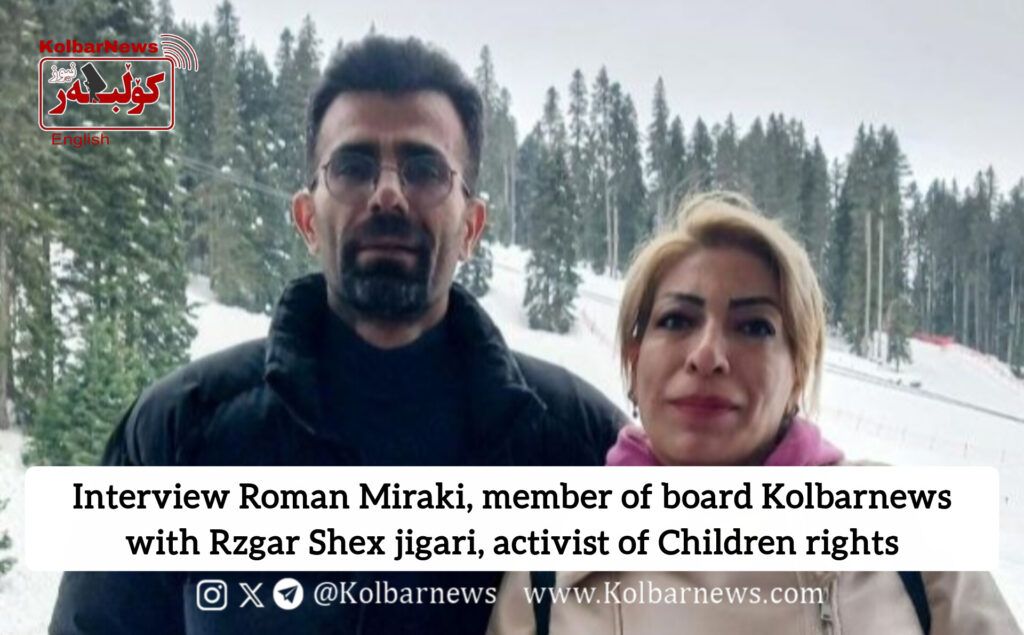
Roman: If you want to describe the current situation of children in Iran in a general picture, what is the most important crisis or danger threatening their lives?
Rizgar: The greatest danger today is the “burning of hope” and the plundering of childhood. When a child is deprived of standard education, healthy nutrition, and psychological security, they not only lose their present, but they will also lack the ability to improve their social class in the future. This means that poverty and deprivation are rigidly reproduced from generation to generation, confronting society with a deep human trauma and crisis.
In a general overview, the most important dimensions of this concerning picture can be summarized in the following points:
The crisis of dropping out of school and child labor
Nutritional poverty and the threat to physical health
Psychological insecurity and structural and domestic violence
The compounded situation of undocumented and migrant children
Psychological trauma following the January protests and the recent war
Roman: What impact have the recent war, insecurity, economic pressures, and tense political atmosphere had on the mental health, sense of security, and future of children especially those living in border and more deprived regions?
Rizgar: Political tensions and the shadow of war are like a silent earthquake. The physical structures might remain standing, but the psychological structure of the generation that must build tomorrow suffers deep cracks. Today, a child in border and deprived regions fights simultaneously on three fronts: poverty, psychological insecurity, and a dark future horizon. Without creating safe educational spaces, focused psychosocial support, and macro level deescalation, this generation will reach youth carrying a heavy burden of repressed anger and accumulated trauma.
The multi layered pressures of recent years in Iran ranging from the heavy shadow of military and wartime tensions to political gridlock and the livelihood crisis have created a suffocating atmosphere, the most invisible trauma of which is carried by children. Meanwhile, children in border and more deprived regions (such as Sistan and Baluchestan, Kurdistan, Khuzestan, and Ilam) are on the front lines of this harm; in these areas, nationwide crises intertwine with chronic environmental deprivation, leaving a compounded impact.
The impact of this tense atmosphere on the mental health, sense of security, and future of these children can be examined across several deep layers:
The erosion of “fundamental psychological security” and existential anxiety
The greatest psychological harm of the recent wartime atmosphere and political tensions is the destruction of the concept of “home and the world as a safe place” in the child’s mind. Hearing continuous news about the possibility of conflict, the flight of drones and missiles, and witnessing anxiety on their parents’ faces subjects children to “constant existential anxiety.”
This issue manifests itself in the form of stuttering, bedwetting, nightmares, nail biting, and severe separation anxiety from parents.
In border regions: The situation is far more acute. The heavier presence of military forces, checkpoints, and the physical resonance of tensions along the borders give the child the feeling of living in a “permanent military garrison”, where a catastrophic event could happen at any moment.
The Phenomenon of “Precocious Adulthood” and the Trauma of Livelihood
When the political climate becomes intertwined with economic crises, children are forced to assume roles far beyond their age.
Daily household conversations about inflation, poverty, and the inability to pay rent or afford food turn the child into a “partner in their parents’ economic anxieties.” This phenomenon robs them of their childhood a time that should be defined by play, curiosity, and peace of mind.
In border regions: This economic pressure manifests in bitter realities such as “children Kolbari” (backpack carrying/smuggling) or “children fuel carrying.” A child living in border areas not only hears news of conflict and tension but also directly risks their life on treacherous border paths just for their family’s survival.
The trauma of losing classmates or loved ones on these paths leaves a deep psychological wound that may never heal.
Structural Hopelessness Toward the Future
A tense political climate and the lack of a clear horizon rob children and adolescents of their ability to dream. When the adults in a society constantly talk about emigration, despair, and dead ends, children experience a form of “creativity depression.”
They see no reason to strive in school or cultivate their talents because they perceive the future as dark, unpredictable, and entirely out of their control.
Untreated Post Traumatic Stress Disorder (PTSD)
In addition to macro level tensions, children in marginalized and border regions grapple with environmental crises such as severe dust storms, water scarcity, and a lack of standard educational facilities. The combination of these hardships with a securitized atmosphere and recent military tensions has manifested clear symptoms of Post Traumatic Stress Disorder (PTSD) in them. Because access to counselors, child psychologists, and mental health support systems is virtually nonexistent in these areas, these traumas become deeply ingrained within the child. In adulthood, they resurface as severe depression, aggression, or a tendency toward high risk behaviors.
Roman: To what extent has the escalation of poverty and economic social crises led to an increase in child labor, school dropouts, early marriage, or forced migration among children?
Rizgar: The escalation of poverty and socioeconomic crises acts as a chain reaction of triggers, playing a direct and devastating role in shattering the security of children. When families grapple with unchecked inflation, unemployment, and the poverty line, children become the first casualties, sacrificed for the sheer survival of the entire family.
The relationship between these crises and the four main harms can be analyzed as an eroding cycle:
Child Labor and School Dropouts
Absolute poverty transforms the phenomenon of “child labor” from a social anomaly into a family survival strategy. On one hand, the rising costs of education (stationery, clothing, transportation), combined with the family’s desperate need for even a meager income on the other, turns education into a luxury item.
Children especially in marginalized and deprived areas are forced to drop out of school to work in informal sectors such as waste picking, street vending, underground workshops, or agriculture. They endure dangerous working conditions for dismal wages, and this exclusion from education guarantees the persistence of poverty for the next generation.
Early and Forced Marriage (To Reduce Family Expenses)
Economic crises directly spike the rates of “child marriage”, particularly among young girls. In the context of extreme poverty, families begin to view girls as an “economic burden.” The early marriage of a girl means one less mouth to feed at the family table and, in some cultures, serves as a means to collect a dowry or settle debts.
Beyond causing severe psychological and physical trauma (such as the high risks of underage pregnancy), this phenomenon permanently strips girls of any opportunity for social growth, education, and economic independence.
Forced Migration
Economic insecurity and the collapse of social structures displace families, forcing children into perilous migrations. When there is no horizon for survival in their place of origin, forced migration occurs either internally from villages to urban slums, or internationally. Amidst this, the phenomenon of “unaccompanied migrant children” is on the rise (as seen in cases like Syria and Afghanistan).
These four phenomena are not isolated; they actively reproduce one another. A migrant child is highly likely to enter the informal labor cycle; child labor leads to dropping out of school; and a girl dropping out of school paves the way for early marriage. The epicenter of all these harms is a lack of systematic social support and structural poverty the root cause of which is the Islamic Republic.
Roman: What dual challenges do children in Iran’s peripheral (border/marginalized) regions face regarding education, their mother tongue, and equal access to educational and economic opportunities? How do these deprivations affect their identity and self confidence? In such context, how can unconventional and high risk phenomena like “Kolbari” (carrying heavy loads across border paths) and “Sohtbari” (fuel smuggling), which involve many children in these regions, be understood and analyzed?
Rizgar: From the moment they enter the formal education system, children in peripheral regions face a massive psychological and cognitive barrier.
The Mother Tongue Barrier
Persian is the official language of instruction in Iran. For a child who has spoken only Kurdish, Balochi, Arabic, or Turkish up until the age of six, entering school means simultaneously learning academic concepts and an entirely new language. The absence of a standardized bilingual education system leads to severe academic decline, feelings of inadequacy, and ultimately, the highest dropout rates in these regions.
Structural and Physical Deprivations
The severe shortage of educational spaces, the existence of makeshift or dilapidated schools, the lack of standard heating and cooling systems, and the long distances to schools (especially for middle and high school levels in rural areas) make accessing education incredibly difficult.
Unequal Economic Opportunities
Due to the lack of industrial and economic infrastructure development in the periphery, even holding an academic degree does not guarantee employment. This reality severely diminishes the motivation of families and children to pursue higher education.
Impact on Identity and Self Confidence
Exclusion from education and the failure to reflect the mother tongue and culture within the official framework inflict deep wounds on a child’s psyche:
Identity Crisis and Alienation: When a child’s language, history, and cultural symbols are ignored or marginalized in textbooks and official spaces, they experience a form of “cultural alienation.” The child feels that their identity is “second class” or unofficial.
Suppression of Self Esteem: The inability to compete fairly with peers in the central regions (who are fluent in the official language and enjoy abundant resources) institutionalizes a sense of frustration and low self confidence. They mistakenly believe that this inequality stems from their own lack of talent, rather than an unfair system of resource distribution.
The Entry of Children Into High Risk Activities
The entry of children into high risk activities such as Kolbari (carrying heavy loads across border paths) in western regions and Sokhtbari (fuel carrying) in eastern and southeastern regions is far beyond a personal or even family choice; it is a “structural compulsion.”
To understand and analyze this phenomenon, several key perspectives must be considered:
A) A Survival Economy Instead of a Development Economy
In regions where hidden and overt unemployment rates are extremely high, and where there are no factories, industries or modern agriculture, the border becomes the sole source of income. In this geography, Kolbari and Sokhtbari are not professions, but rather brutal mechanisms for daily survival. When the head of a household becomes incapacitated due to illness, old age, or border incidents, children are forced to assume the role of breadwinner.
B) The Phenomenon of “Child Labor” in its Most Raw Form
Children Kolbari and Sokhtbari represent the most severe and dangerous manifestations of child labor. Instead of experiencing childhood and play, these children grapple with realities like road accidents, exploding fuel vehicles, falling from cliffs, hypothermia, and border ambushes. These experiences inflict irreversible psychological trauma, such as Post Traumatic Stress Disorder (PTSD).
C) Reproduction of the Cycle of Poverty and Deprivation
A child’s entry onto this path marks the definitive end of their education. Without schooling or acquiring specialized skills, this child will have no option in adulthood but to continue these exact same high risk activities. Consequently, deprivation is transmitted from one generation to the next, leaving the region trapped in a developmental dead end.
Until the perspective toward peripheral and border regions shifts from a securitized marginalized framework to one that is development oriented, structural, and rooted in educational justice, these destructive cycles such as school dropouts and children turning to false, fatal border occupations will persist.
Resolving these challenges requires recognizing cultural diversity, investing economically in local infrastructure, and establishing powerful support networks for vulnerable children support that has been completely denied to these children throughout the 47 year existence of the Islamic Republic.
Roman: In recent years, many children have directly experienced detention, the loss of family members, street violence, or an atmosphere of repression. What long term consequences will these experiences have on the future generation?
Rizgar: Direct exposure of children to violent phenomena such as detention, the sudden loss of family members due to political and social violence, or living in a perpetual atmosphere of repression and intimidation, inflicts one of the deepest forms of trauma. When raw anger and oppression penetrate the sanctuary of childhood, the consequences do not remain individual; rather, over time, they transform into a “collective and generational trauma.”
Children who go through such harrowing experiences face fundamental changes in their psychological and even brain structures:
Chronic Post Traumatic Stress Disorder (PTSD): Constantly reliving scenes of violence, nightmares, severe anxiety, and hyper vigilance are early signs of this condition. The child’s nervous system remains trapped in a perpetual state of “survival” or “fight or flight,” stripping away their psychological peace.
The Collapse of the Concept of a “Safe World”: For a child, the world must be a predictable and safe place where adults (parents or social institutions) protect them. The detention of a child or seeing their family harmed before their eyes completely destroys this mental assumption. When a child’s primary sanctuary (home and family) becomes unsafe, they fall into a state of absolute psychological displacement and defenselessness.
Unexpressed and Complex Grief: Losing loved ones in a context of violence is fundamentally different from natural death. The inability of families to mourn freely, combined with guilt and suppressed anger, turns grief into a complex psychological knot.
At a macro level, the impact of these experiences on the social behavior of the future generation manifests in the following patterns:
The Normalization and Internalization of Violence: A child who grows up witnessing street violence and repression learns that “might makes right” and that “force is the ultimate language to resolve any conflict.” In the future, this can lead to an increase in domestic violence, social delinquency, and interpersonal conflicts.
A Deep Rift Between the New Generation and Official Institutions:
When the primary source of insecurity and fear in a child’s mind is the ruling and official structures of the country, a sense of national belonging and citizenship fails to form. This generation will grow up with a mountain of absolute distrust toward the law, the police, and any civil institution, making the management of society extremely difficult.
One of the most horrific dimensions of these traumas is their persistence beyond the current generation. Crisis psychology studies show that untreated psychological injuries are transmitted to subsequent generations like a biological and behavioral legacy.
Parents who have had a traumatic childhood themselves, if not given the opportunity and means for psychological recovery and healing, will unconsciously reflect their anxieties, cynicisms, and defensive behaviors in the way they raise their own children. Consequently, society will carry the heavy psychological burden of a period of repression for decades to come.
The impact of this era on the general direction of this generation usually culminates in two completely different yet profound paths:
The First Path: Disillusionment and Isolation
The Second Path: Identity Formation Around the Axis of Seeking Justice
The children who are breathing in an atmosphere of repression, violence, and detention today will build tomorrow. A society that remains indifferent to the psychological and physical security of its children today or acts as the source of their intimidation will face a generation in the future that is either hollowed out and hopeless from within, or filled with open, unhealed wounds ready to rupture at any moment. Healing this volume of trauma in the future will require long term processes of collective psychotherapy, truth seeking, and most importantly, a radical change in the conditions that generated this injury in the first place.
Roman: Despite all these pressures and crises, what is most essential today to protect children? And what responsibilities do civil society, child rights activists, and international organizations hold?
Rizgar: Why does the Islamic Republic exert pressure on independent child rights institutions and activists (especially in marginalized and deprived areas), arrest them, and fabricate baseless judicial cases against them.
The objectives behind exerting these pressures can be summarized in a few main key aspects:
Fear of the Emergence of Independent “Alternative Networks”: The security apparatus’s greatest fear is the formation of any social network independent of the state, especially if that network has the power to mobilize the masses or win the deep trust of the people. Because NGOs have an on the ground presence in marginalized neighborhoods, they directly connect with the vulnerable classes of society (who are the regime’s Achilles’ heel during economic and social protests). The state worries that over time, these institutions will turn into a “social authority” that replaces official entities (such as the Basij or the Imam Khomeini Relief Foundation) and hold the capacity to guide or organize dissent during times of crisis.
Monopolization of Ideology and Child Upbringing: From an ideological standpoint, children and adolescents are the most vital segment of society for reproducing the regime’s values. Independent child rights activists usually operate based on international documents (such as the UN Convention on the Rights of the Child), modern education, contemporary psychology, and concepts like gender equality and the abolition of child labor. The state views these types of education as “Western cultural infiltration” or “colonial projects (such as the UNESCO 2030 Agenda).” The goal of this pressure is to halt this modern approach and replace it with indigenous, ideological training controlled by state affiliated institutions, ensuring that control over the minds of the new generation is not lost.
Systematic Concealment of Social Ills: Marginalization, absolute poverty, child addiction, and high school dropout rates are clear indicators of the system’s structural inefficiency. By documenting these conditions, publishing statistics, and reporting, child rights activists effectively lay bare this incompetence. The regime considers the reporting of these bitter realities as “muddying the waters” (painting a dark picture) and “feeding foreign media.”
Exerting pressure and arresting activists is a strategy to eliminate the problem altogether and choke the voices of those reporting on the status quo, ensuring that the image presented of the country remains entirely under its own control.
Financial and Security Labeling (Accusations of Foreign Affiliation): Many independent institutions are forced to secure international aid or collaborate with global human rights organizations in order to survive or implement large scale projects. Within the conspiracy driven worldview of the security apparatus, any financial or information sharing link outside the borders is defined as a “soft overthrow project” or “espionage.” Arresting activists under these pretexts sends a clear message to others that no one has the right to maintain connections with the outside world outside of government sanctioned channels.
The Link Between This Objective and the Status of Activists and Networks: Given these objectives, the pressures are precisely engineered to “decapitate” civil society. The regime prefers independent support networks to completely fall apart even if it comes at the cost of abandoning thousands of children to the clutches of poverty and delinquency rather than allowing an independent and critical network to exist among the lower social classes.
In this puzzle, activists who want to endure realize that the regime will not tolerate the banner of “child rights” and “structural work”. Therefore, they are forced to reduce their activities to the level of “pure, traditional charity” (providing food and clothing without education and advocacy) to avoid triggering security sensitivities. Alternatively, as mentioned in the previous response, they must shift entirely toward capillary (underground) and clandestine activities.