
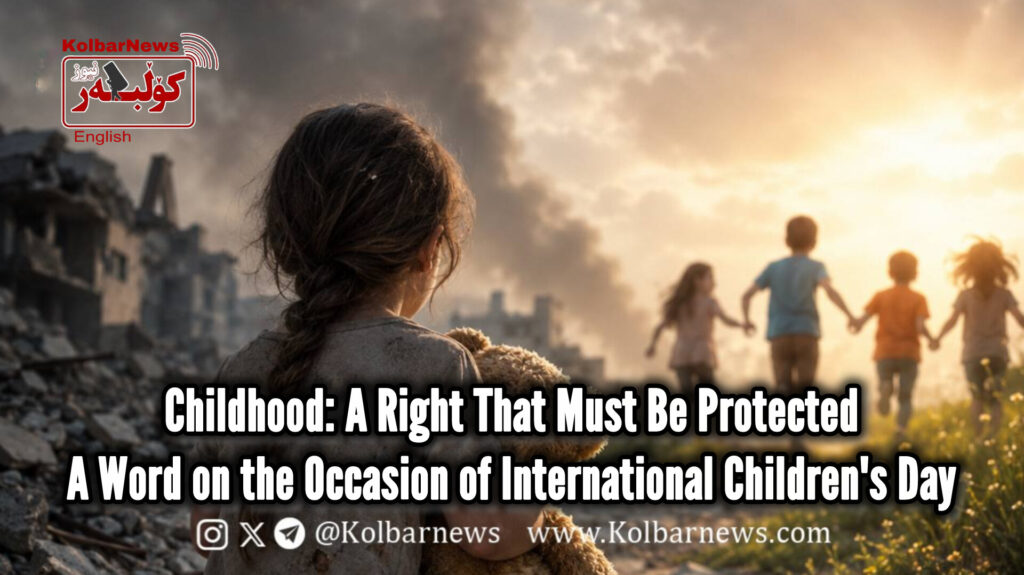
International Children’s Day is a day chosen by the world to honor children and to reaffirm their human and social status. This day is observed on different dates in different countries “June 1 in some and November 20 in others” but regardless of calendar differences, the message remains the same: children are the future of humanity and must enjoy all of their human rights.
In a humane society, childhood should be a time of discovery, play, imagination, and the development of personality; a period during which children learn that the world can be a safe and wonderful place. Yet for millions of children around the world, daily reality consists of nothing but war, poverty, discrimination, exploitation, and political repression, forces that destroy childhood at its roots and carry a wounded generation into adulthood.
In the two recent wars between the United States and Israel and Iran, as in many regional conflicts, children have been among the most defenseless victims. The Minab tragedy is a painful example of this reality: 160 schoolchildren were killed in the first wave of bombardment while sitting at their classroom desks.
Beyond Iran’s borders, Israeli and Lebanese children were also wounded or killed under missile fire. For those who survive, war means constant fear, sleepless nights, a school that no longer exists, a home reduced to rubble, and laughter transformed into tears or silence. In a single moment, a child’s home, school, games, peaceful sleep, and sense of security “the very foundations of childhood” can be destroyed.
One of the deepest wounds of war is the wound inflicted upon children’s minds, a wound that does not appear in official statistics or news images but remains with them for years. Children in Tehran, Tel Aviv, Beirut, and other war-affected cities may suffer nightmares, fear loud noises, become isolated, or display aggressive behavior. Even when war does not strike a child’s body, it targets the mind. Most tragic of all, violence can become “normalized” for these children. A generation raised in fear and hatred will inevitably reproduce that fear and hatred in social relations, culture, and politics.
In Gaza, the Israeli military has killed tens of thousands of children during two years of war. A catastrophe of horrifying proportions and a stark example of organized violence against children. This massacre has unfolded before the eyes of the world and with the direct or implicit acquiescence of the United States government and its allies. In such a world, speaking of “children’s rights” without seriously confronting structures of power resembles hypocrisy more than genuine humanitarian concern.
In Iran under the rule of the Islamic Republic, the condition of children represents a dark chapter in the record of human rights violations. During the “Woman, Life, Freedom” movement, more than 70 children and adolescents under the age of 18 lost their lives in less than a year. At the same time, hundreds of girls’ schools across the country were targeted with poisonous gases, resulting in the poisoning of thousands of students, an act intended to intimidate the younger generation and society as a whole.
Iran remains the only country where individuals for offenses committed under the age of 18 can still face execution. The prisons of the Islamic Republic are filled with teenagers incarcerated because of poverty, parental addiction, minor offenses, street altercations, or political protest. In many schools, corporal punishment remains common, while millions of children from working-class and low-income families are deprived of education and forced into degrading and difficult labor, from waste collection and street vending to work in underground workshops.
The Islamic Republic’s policies toward children have a long history. During the eight-year Iran-Iraq War, the organized use of children on the front lines, sending teenagers into minefields, and glorifying the “martyrdom of children” formed part of official state policy. Today, the use of children in the Basij, government-organized marches, religious mourning ceremonies, and even in street repression reflects the continuation of the same logic. The instrumental use of children’s bodies and minds for political and ideological purposes falls within the conceptual framework of crimes against humanity.
Schools should be safe spaces for learning, friendship, creativity, and critical thinking. Yet in many Iranian schools, childhood is appropriated from the moment children enter the school gates. Children are segregated by gender from their earliest years. Young girls are compelled to observe mandatory hijab from their first day of school, and their bodies become subjects of control and surveillance rather than simply aspects of their human identity. In such an environment, attitudes of dominance and patriarchy are reinforced among boys, while obedience and submission are encouraged among girls.
School textbooks are filled with religious and ideological instruction. Clerics, seminary students, and paramilitary forces are sent into schools to promote a culture of informing, surveillance, and mutual control among children. Nine-year-old girls participate in “religious obligation ceremonies,” where compulsory hijab and religious practices are presented as celebrations of maturity, and they are encouraged to accept traditional roles, including early marriage.
A child who grows up in such an environment “one filled with fear, humiliation, gender discrimination, and superstition” has little opportunity for happiness or free personal development. The consequences of this repression can last a lifetime, ranging from chronic anxiety and diminished self-confidence to difficulties in establishing healthy relationships with oneself and others.
If International Children’s Day is reduced to cheerful ceremonies, television programs, poetry readings, and school decorations, without addressing the structures that kill, exploit, frighten, and break children, it becomes an empty performance. Genuine recognition of childhood means struggling for transformation.
- To change the current situation, specific objectives must stand at the center of social struggle, including:
- The prohibition of child labor and the guarantee of free, high-quality, universal education for all, regardless of class, ethnicity, gender, or religion.
- A complete ban on corporal punishment in homes, schools, and all educational and childcare institutions.
- The abolition of the death penalty, especially for children and adolescents, and the reform of criminal laws based on human dignity.
- The absolute prohibition of arming children or using them in paramilitary forces, government marches, or political conflicts.
- The removal of religion and official ideology from the educational system and their replacement with scientific and critical education.
- The expansion of and meaningful support for independent child-rights organizations instead of repressing and securitizing their activities.
The full implementation of international conventions on the rights of the child and their adoption as benchmarks for educational, judicial, and social policies.
If International Children’s Day has any meaning, it is to remind ourselves and the world that no ideological, religious, security-related, or economic justification can legitimize the violation of childhood. Defending children means defending the future, and any society that sacrifices its children destroys its own future with its own hands.