

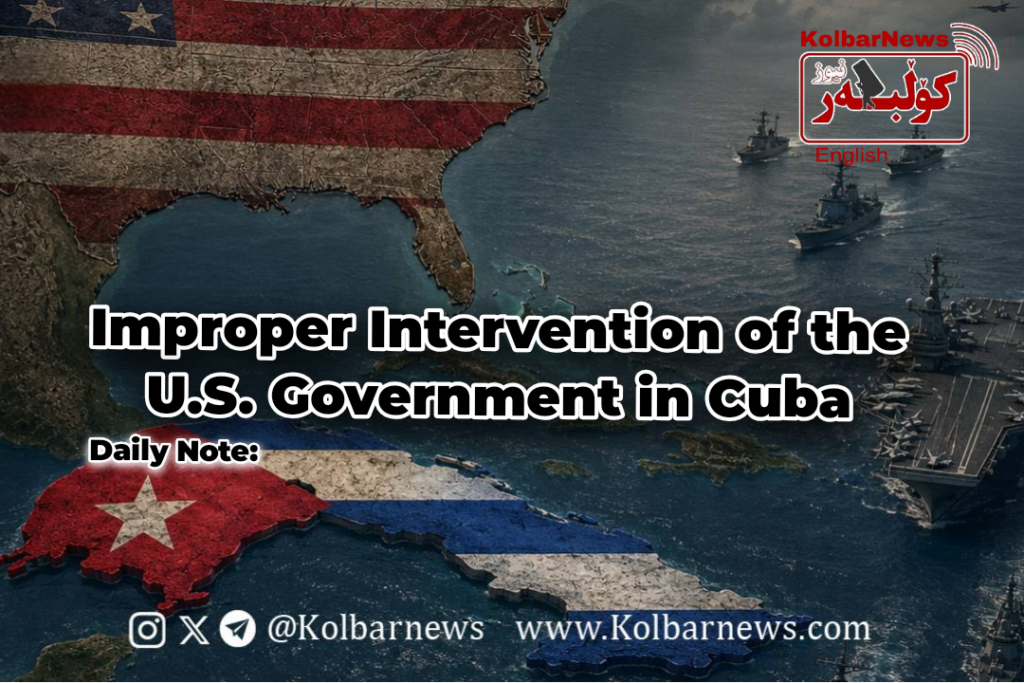
The long-standing tense relations between the United States and Cuba have once again entered a critical stage. Through its “maximum pressure” campaign, the U.S. government has imposed the harshest sanctions and oil blockade against this small Caribbean island. These pressures have led to widespread shortages of fuel and food, as well as prolonged blackouts in Cuba, pushing the country to the brink of economic collapse. But to understand the roots of this crisis, one must look at the long history of American intervention in the affairs of the island; a history stretching back more than a century.
American intervention in Cuba began at the end of the nineteenth century. After the Spanish-American War in 1898, the U.S. government effectively took control of Cuba’s foreign and domestic policy and granted itself the right of military intervention in the country. During the following decades, American companies took control of most of Cuba’s agricultural lands, mines, and industries, while the majority of the Cuban people lived in poverty.
After the 1959 Revolution and the rise of Fidel Castro to power, the United States used every tool at its disposal to overthrow the revolutionary government. The most disgraceful example of these efforts was the Bay of Pigs operation in 1961, an invasion that ended in failure for the United States. The CIA also designed dozens of assassination plots against Fidel Castro, all of which failed. The economic blockade that began in 1962 has continued for more than six decades and has become one of the longest economic sanctions regimes in history.
These sanctions have had only one objective: suffocating Cuba’s economy and imposing regime change through pressure on the people. For years, the United Nations has condemned these sanctions by overwhelming majorities, yet the United States continues this unjust blockade.
Today the same logic is being repeated. One of the radical options reportedly on Trump’s table is direct U.S. military action to eliminate key figures in the Cuban government. After the U.S. Department of Justice filed charges against Raúl Castro over the downing of two civilian aircraft in 1996, speculation has increased regarding the possibility of a military operation to capture him.
Such an action would not be unprecedented. Last January, American special forces carried out a similar operation in Venezuela, resulting in the capture of Nicolás Maduro. In 1989, the invasion of Panama by thousands of American troops led to the arrest of Manuel Noriega. This recurring pattern demonstrates that the United States still sees itself as possessing a unilateral right to military intervention in independent Latin American countries; an approach rooted in the Monroe Doctrine, which regards Latin America as its backyard.
At the same time as pressure has intensified, the U.S. government has also kept the door to diplomacy open. Donald Trump has stated that he is in contact with individuals inside Cuba, while Secretary of State Marco Rubio has emphasized the administration’s preference for achieving “a negotiated agreement.” The United States seeks changes such as opening Cuba’s economy, attracting foreign investment, and ending Russian and Chinese influence on the island.
Referring to Cuba’s economic situation, Trump stated: “There will be no need for escalation… it is collapsing.” But this collapse is the direct result of sanctions imposed by the United States itself, a reality Trump prefers not to mention.
At the same time, Cuba has achieved accomplishments in some fields that many wealthier countries have failed to attain. Cuba’s free and universal healthcare system is recognized as one of the best healthcare systems in the developing world. A literacy rate of one hundred percent, free education at all levels from elementary school to university, and widespread vaccination programs that have reduced child mortality to the lowest level in the region are among these achievements. Cuba has also sent its doctors and nurses to dozens of poor countries in Africa, Latin America, and Asia; a form of humanitarian diplomacy more compatible with human values than the deployment of military forces. These achievements demonstrate that the people of Cuba deserve respect and cooperation, not blockade and sanctions.
These achievements do not mean that Cuba is a flawless society. Bureaucratic inefficiencies, weak incentives for innovation, administrative corruption, and excessive dependence on the state as the principal employer are real problems. Daily blackouts, long queues, and shortages of food are painful realities in Cuba today. But the essential point is that reforming these problems must emerge from within Cuban society itself and from the will of its people, not through blockade, military threats, or the imposition of a neoliberal model from outside.
Cuba is a small island with a resilient people who have lived under blockade pressure for more than six decades. They are neither a “national security threat” to the United States nor deserving of collective punishment; they deserve respect, cooperation, and a genuine opportunity to build their own future.
Defending Cuba against aggressive U.S. policies does not mean ignoring the country’s internal problems, it means recognizing that no people should be brought to their knees for choosing a different path.