
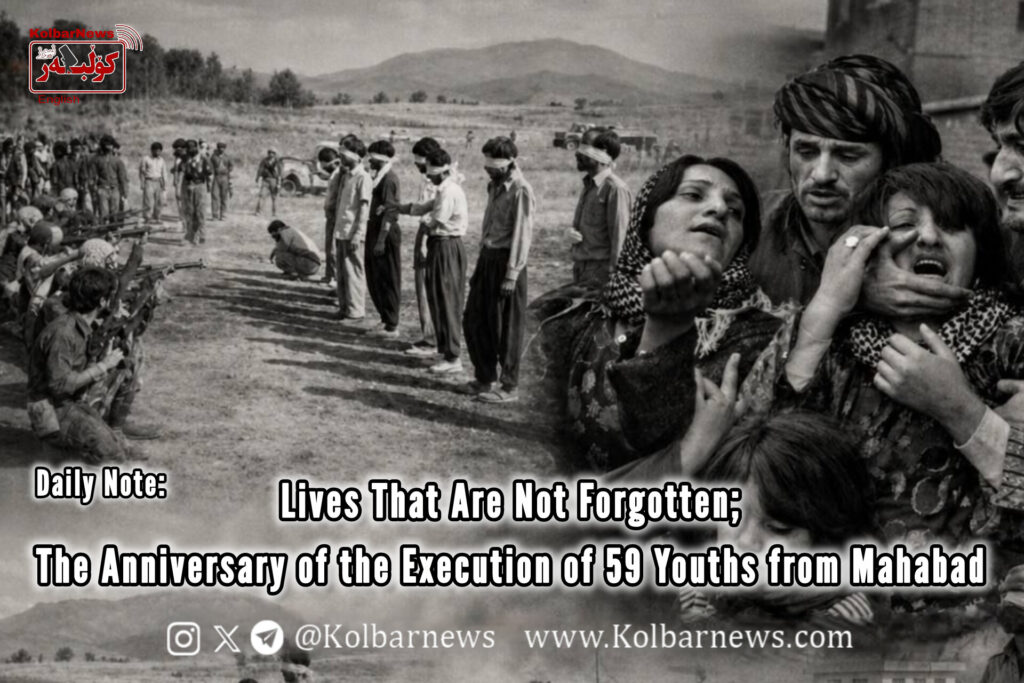
June 2, 1983. On that morning, the people of Mahabad were confronted with a notice distributed throughout the city by the governor’s office. A list of names. Fifty-nine names. Fifty-nine young men and teenagers who had been executed. The same individuals who had been taken from the streets months earlier. The same people whose families did not know where they were and now did not know where they had been buried.
The story had begun in March and April 1983. Regime forces were searching the streets of Mahabad for victims, not because of any specific crime, nor on the basis of a documented case. Young people were arrested as they left their homes, at street corners, in the bazaar, and on their way to school. Many of them had not yet reached the age of eighteen. Several were high school students; one was a second-year student at Ibn Sina High School in Mahabad.
The accusation? Affiliation with Kurdish political parties and organizations. A charge that was neither proven in court nor challenged by a lawyer on their behalf. A trial lasting only a few minutes in the Revolutionary Court of Tabriz was followed by the issuance of death sentences.
To understand what happened that day, one must return to the weeks preceding it. Mohammad Boroujerdi, the principal commander of the Islamic Revolutionary Guard Corps’ operations in western Iran and the chief architect of the campaign against Kurdish peshmerga forces, had been killed. His death was a major blow to the regime. One after another, Prime Minister Mir-Hossein Mousavi, Akbar Hashemi Rafsanjani, and Mohsen Rafiqdoust, Minister of the IRGC, attacked Kurdish political organizations and called for the harshest possible response. A regime that had suffered setbacks on the battlefield decided to vent its anger on a population that held no weapons. The fifty-nine youths of Mahabad became victims of this retaliation.
Among those whose names have been linked to this crime are Hamidreza Jalaipour, then governor of Mahabad, who years later adopted the mantle of reformism; Mohammad Ebrahim Sanjaghi, commander of the Hamzeh Headquarters; Ali Akbar Nategh-Nouri, Minister of Interior; Gholamreza Hassani, Friday Prayer Imam of Urmia; and Ali Sayad Shirazi, commander of the Army Ground Forces.
After the executions, the families were not even informed of the burial sites of their children. No graves, no markers, no tombstones. Fifty-nine lives ended within minutes and disappeared into silence beneath the earth. This imposed silence was itself part of the punishment, not only for those who were executed, but also for the mothers, fathers, sisters, and brothers who were denied even the opportunity to mourn at the graves of their loved ones.
But the people of Kurdistan did not remain silent. On June 7, 1983, following a joint call by Komala, the Kurdistan Democratic Party of Iran, and Mamosta Sheikh Ezzeddin Hosseini, Kurdistan came to a standstill through a general strike. The strike in Mahabad continued for several days. It was the first coordinated general strike in Kurdistan, demonstrating that the people would not surrender to intimidation in the face of such crimes.
The execution of the 59 youths of Mahabad was neither the beginning nor the end of this pattern. Throughout the 1980s, the Islamic Republic repeatedly resorted to the same methods: mass arrests, summary trials, and large-scale executions. This process reached its peak in the summer of 1988, when thousands of political prisoners across the country were executed in less than two months. Yet the Mahabad massacre occupies a special place because most of its victims were teenagers taken directly from the streets, without evidence, without defense, and without due process.
Today, forty-three years after that day, many aspects of this crime remain shrouded in darkness. The exact locations of the graves remain unknown. There are still families who possess nothing more than the list of names printed on that governor’s office notice.
But they have not been forgotten. These names “these fifty-nine names” remain alive in the collective memory of the people of Kurdistan. Preserving this memory is not merely a historical duty; it is the most fundamental form of resistance against those who sought, by hiding the graves, to erase even the names of these young people from memory. The blood that disappeared into the soil continues to flow through remembrance.
The victims of the crime of June 2, 1983, were:
Gholamreza Barezi
Hassan Jahanian
Ali Baneyan
Mohammad Aliali
Mohammadamin Safa
Homayoun Niloufari
Mahmoud Riazi
Mohammad Hosseini
Abbas Hosseinpour
Kazem Khatouni
Ali Mazneh
Abdollah Tahririan
Rahman Rahimi
Ali Golparast
Mostafa Esmati
Khalegh Barzani
Yousef Ayazi
Kamal Chavashini
Hassan Rahmanian
Khaled Rahimi-Azar
Khaled Safaei
Seyed Ebrahim Ahmadi
Mohammad Masoudi
Mohammad Abubakri
Vafa Elyasi
Mansour Janah
Mohammadamin Ahmadi
Mohammad Salimi
Fereydoun Shangeh
Ali Bazian
Khezr Rangin
Abubakr Shokri
Mashaallah Naderi
Hajar Karimi
Kamal Karimi
Karim Kalehri
Yousef Habib-Panah
Mohammad Farough Bazyar
Ebrahim Amini
Saleh Mam-Ebrahimi
Shokri Naderi
Mostafa Faghri
Ali Ghawareh
Ali Salahi
Molla Hassan Lajevardi
Soleiman Hassanzadeh
Yousef Hassanzadeh
Karim Kaveh
Seyed Mahmoud Seyedmahmoudi
Hamed Mahmoudkandi
Hossein Kalehri
Abbas Yousefi
Siamak Saqqezi
Ali Abadeh
Kamran Zaher Hejazi
Saleh Farhoudi
Maqsoud Mahmoudi
Ahmad Karoubi
Rahman Khezrpour
Four months after the mass execution of the Mahabad youths on June 2, 1983, the Iranian regime, having failed to achieve its objectives through those executions, committed another crime. It abducted 33 more young men and again sent them before firing squads in Tabriz:
Ahmad Babasouri
Jafar Poursoltani
Abdolrahim Mamali “Nejat”
Mohammad Sabzehchi
Nasser Handoush
Mahmoud Ebteda
Ghader Bayzidi
Rasoul Rashidi
Soleiman Ahangari
Soleiman Pirotzadeh
Soleiman Molani
Khosrow Sazvari
Ghadir Kakamami
Karim Peyghambarnejad
Mohammad Jannati
Hassan Jannati
Ali Bamdad
Younes Pirzadeh
Ali Azargouta
Karim Ahmadi
Rahman Bangin
Seyed Alaeddin Hosseini
Soltan Banaei
Yousef Abed
Jafar Hassanzadeh
Jafar Esmati
Yousef Mohammadi
Khoshnaw Ghazizadeh
Mohsen Aliyeh
Fayegh Karimi
Jafar Pakzad
Ahmad Amini
Jafar Mam-Ramezani
Due to the lack of sufficient information regarding judicial proceedings, case files, and execution dates, it remains unclear whether the following individuals were executed collectively with the 59 victims or separately:
Ali Takamchi
Younes Pirdokht
Seyed Ebrahim Seyedahmadi
Nasrin Kal
Osman Baturk
Ali Salami
Masoumeh Sarhangi
Abubakr Partovian
Khaled Masmari
Habib Khatami
Ali Ghawara
Masoud Mirmahmoudi
Mohammad Masoud Zaer Hejazi
Seyed Anvar Shokri
Abdollah Ahangari
In 1983, more than 250 people from Kurdistan were abducted and executed in Tabriz over a period of four months.
We honor the memory of these victims and pay tribute to the resistance and perseverance of their proud families.