

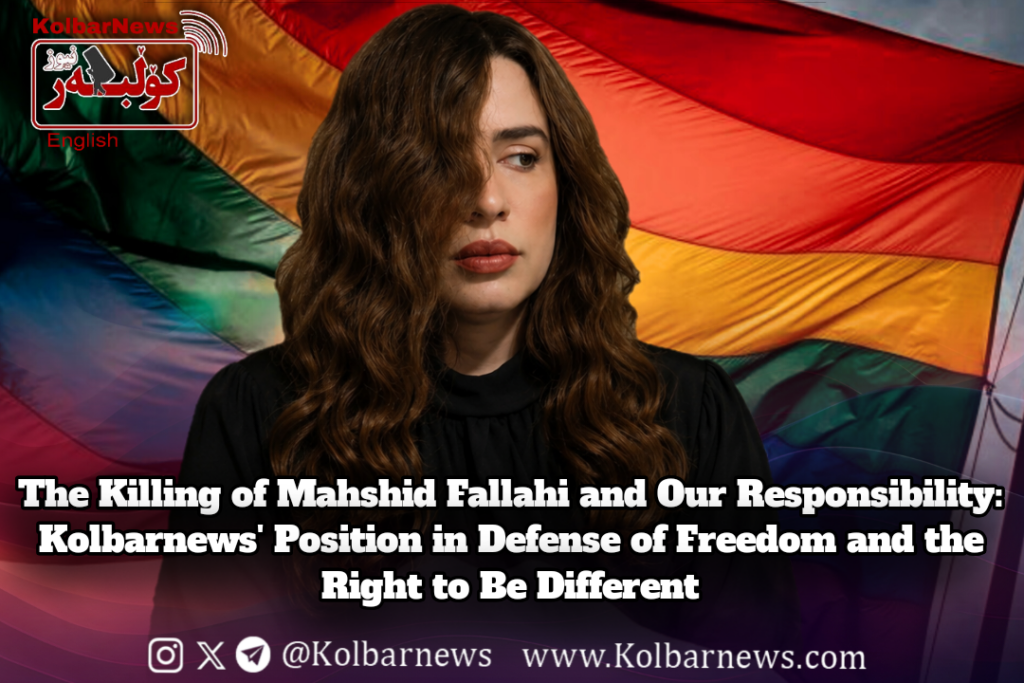
The killing of Mahshid Fallahi, a 32-year-old trans woman in Sanandaj, is not merely a murder; it is a reflection of the structural violence, institutionalized discrimination, and social exclusion that have affected the lives of LGBTQ individuals in Iran and Kurdistan for many years. Long before she lost her life to stab wounds, Mahshid had already been a victim of another form of violence, a violence manifested through family rejection, homelessness, poverty, social isolation, and the denial of her most basic human rights. Her death is not only the end of a life but also a symbol of the painful fate of many people who are subjected to discrimination by society, religion, and governing structures simply because they are different.
Human society is not composed solely of two groups, women and men. Human beings display a wide diversity of gender identities, gender expressions, and sexual orientations. Transgender, gay, bisexual, queer, non-binary individuals, and other members of the LGBTQ community are a natural and inseparable part of human societies. Psychology, sociology, and medical sciences have long emphasized that gender and sexual diversity are part of the reality of human existence, not a deviation, illness, or crime. Every person has the right to define their identity as they experience it, make decisions about their own body, love freely, and live without fear of humiliation, violence, or punishment.
In Iran, however, laws based on Islamic Sharia and the legal structure of the Islamic Republic not only fail to protect these rights but also contribute to the reproduction of discrimination and violence. The laws of the Islamic Republic are founded upon a patriarchal and heteronormative interpretation of society laws that regard women as citizens with unequal rights and fundamentally refuse to recognize LGBTQ individuals. The criminalization of same-sex relationships, the denial of gender identities outside officially sanctioned frameworks, state-sponsored hate propaganda, and the social exclusion of LGBTQ people have created an environment in which violence against them becomes normalized. When the law and official institutions deny the dignity of a segment of the population, society itself is more easily pushed toward their exclusion and repression.
Under such circumstances, remaining silent about the killing of Mahshid Fallahi is not merely silence in the face of a crime; it is silence in the face of an entire system of discrimination that produces new victims every day. The political, civil, and intellectual community of Kurdistan also bears responsibility in this regard. Kurdistan has long presented itself as a society committed to struggle, equality, freedom, and progress. From women’s struggles to civil and social movements, demands for freedom and equality have consistently occupied an important place within this society. For this reason, defending the rights of the LGBTQ community must also be considered part of the broader struggle for freedom and equality.
The Jina Revolutionary Movement, which began in Kurdistan and became one of the largest freedom movements in contemporary history, is known by the slogan (Jin, Jiyan, Azadi) (Woman, Life, Freedom). This slogan cannot hold meaning for only a portion of society. If life is valuable and freedom is a universal right, then these principles must apply to all human beings from women and men to every member of the LGBTQ community. Freedom cannot be defined selectively, and equality cannot be demanded only for a particular group.
Breaking deeply rooted taboos in traditional and religious societies is an unavoidable necessity for achieving a more humane society. The LGBTQ community is part of the people of Kurdistan and Iran, human beings who have the right to live without fear of violence, exclusion, arrest, humiliation, or murder. Defending them is not a defense of a particular lifestyle; it is a defense of the human right to be different. A society that cannot accept difference will never achieve genuine freedom, and a society that remains silent in the face of discrimination will sooner or later become a victim of that same discrimination itself.
Board of Directors
Kolbarnews