

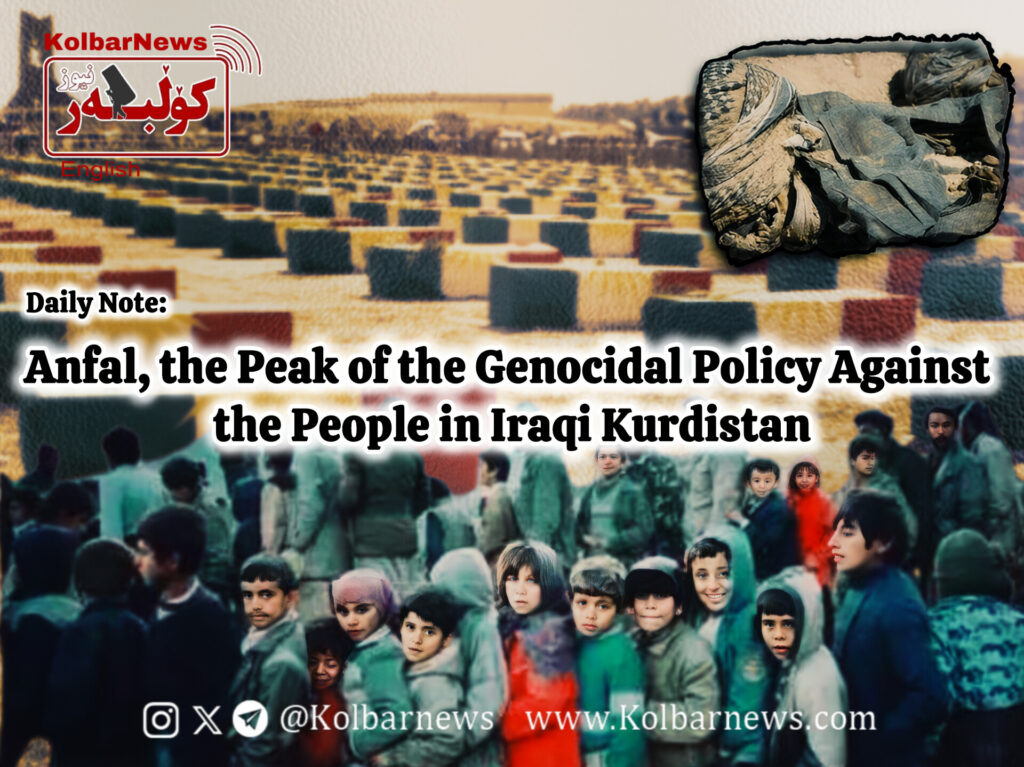
April, coincide with the anniversary of the series of anti-human operations known as “Anfal,” carried out by the Ba’ath regime in Iraqi Kurdistan. A tragedy in which more than one hundred and eighty thousand people were killed, and even after all these years, its psychological, social, and economic effects still weigh heavily on this society. 38 years ago, on days like these, while the 8-year Iran–Iraq war was in its final months, the Iraqi Ba’ath regime made it a military priority to focus on the Kurdistan fronts and deployed hundreds of thousands of armed forces, equipped with tanks, artillery, and various advanced military equipment and air support, along with groups of local mercenaries, into Kurdistan. The declared aim of this war was to eliminate Peshmerga forces, but what was actually carried out was the continuation of an older plan: the policy of genocide against the Kurdish people. Even if there were periods of pause in the execution of this policy, the Iraqi Ba’ath regime, as a matter of policy, never abandoned it.
In 1974, it bombed the city of Qaladiza and massacred its defenseless people. In the same year, a similar bombing in the city of Halabja led to the killing of civilians. In 1976 and 1977, with the aim of creating a security belt as part of the Algiers Agreement, more than 4,000 villages were destroyed. Farms, vineyards, and orchards were burned, springs were dried up, and villagers were forcibly relocated to surrounded camps. Later, it went even further and destroyed the cities of “Qaladiza” and “Said Sadiq” and parts of the city of “Ranya.” In 1979, it forcibly expelled the Faili Kurds from their homes in Baghdad and elsewhere, and many of them were later massacred.
In 1985, it bombed a refugee camp in the Zewa Margor area in Iranian Kurdistan, resulting in the killing of many defenseless people. In 1987, it targeted the inhabitants of villages in the Balisan Valley in Iraqi Kurdistan with chemical bombing and carried out a large-scale massacre, even preventing hospitals from treating the wounded. In the same year, it massacred residents of a neighborhood in the city of Halabja under the pretext of protests.
In 1988, it forcibly transferred eight thousand people from the Badinan region in northern Iraqi Kurdistan to central Iraq and massacred them in the “Jaliya” desert, burying them in mass graves. In the same year, it chemically bombed the city of Halabja and killed 5,000 of its residents old and young, children, women, and men. The operations known as “Anfal” were the culmination of this anti-human policy.
The name Anfal is derived from a term in the Quran meaning “spoils.” The choice of this name for the operation was essentially intended to incite mercenaries to commit crimes, looting, and seizure of property. During this operation, local collaborators working with the Ba’ath regime were allowed to plunder the belongings of people from villages, towns, and settlements that had been forcibly evacuated.
During the series of Anfal operations, thousands of people “women, men, children, the elderly, and youth” were displaced from their homes and living areas, without being allowed to take anything with them except the clothes they were wearing.
These people were transported in groups of several thousand by buses to deserts known as “Ogra Salman” in central Iraq, where they were killed in the most brutal ways. Much later, the few survivors of this tragedy revealed horrifying accounts of these crimes and described parts of those terrifying mass killings. Although no exact figure of the human losses has been determined, estimates indicate that around one hundred and eighty thousand people were killed and buried in mass graves.
The Anfal tragedy, with all its horrific dimensions, occurred in full view of the world’s major governments, foremost among them the United States, and no preventive reaction was shown by them. Global media, operating under the influence of these governments, remained silent in the face of these atrocities. Even now, despite public awareness of the details of this genocide, these horrific crimes against the people of Kurdistan have still not been officially recognized worldwide as genocide by international authorities. This silence and indifference constitute another injustice inflicted upon the people of Kurdistan.
Today, 38 years later, we commemorate the mass killings of Anfal and the victims of this great tragedy at a time when the Ba’ath dictatorship is no longer in power.
Saddam and several of his criminal associates were executed. Although these perpetrators are no longer in power, unfortunately, the people of Kurdistan were deprived of the right to try these criminals themselves in a public court and declare their punishment. Saddam and some of those responsible for the Anfal and Halabja atrocities are gone, but the traces of pain and suffering among the affected people who endured these bitter events still remain.
Many of the local Kurdish collaborators who were employed by the Ba’ath regime in these mass killings not only escaped punishment but also managed to keep the wealth they had obtained from looting the property of Anfal victims, and like a thorn in the eye of the people of Kurdistan, they continue to live their normal lives. Even after 38 years, tens of thousands of Anfal-affected families still suffer from poverty, hardship, and the grief of losing their loved ones.
On the anniversary of this tremendous human tragedy, we express our hatred and condemnation of its perpetrators and honor the memory of more than one hundred and eighty thousand defenseless people who were killed in this genocide.
