

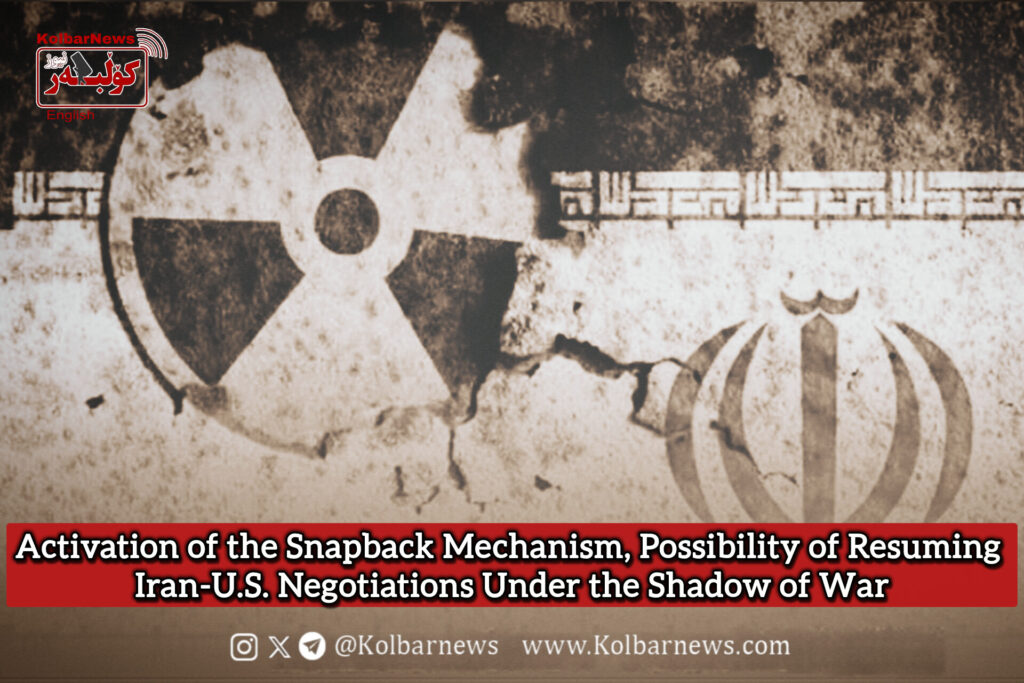
While the shadow of the 12-day war between Iran and Israel and its security consequences still weigh heavily over the entire region, international diplomacy has once again become a stage of confrontation and new possibilities. The recent move by the three European powers (Germany, France, and the United Kingdom) to activate the Snapback mechanism and reinstate previous U.N. sanctions against the Islamic Republic, as well as Tehran’s sharp reaction, has created a tense atmosphere regarding the potential resumption of direct negotiations between Iran and the United States.
The statement by Marco Rubio, U.S. Secretary of State, in support of Europe’s action carries two key messages: first, an emphasis on continuing the path of “maximum pressure,” and second, the U.S. government’s announcement of its direct and unconditional readiness to negotiate with the Islamic Republic of Iran. In reality, the United States aims for nothing other than forcing Iran to swiftly and transparently accept Washington’s demands.
On the other hand, Abbas Araghchi’s letter to the European Union demonstrates the Islamic Republic’s rigid stance: it considers any move to reinstate sanctions invalid and insists on the expiration of Resolution 2231 in October 2025. However, in the same letter, Tehran once again expressed its readiness to resume negotiations described as “fair and balanced,” provided that the other side shows “goodwill” and refrains from destructive actions. This apparent contradiction, rejecting sanctions on the one hand while expressing willingness to negotiate on the other, reflects the Islamic Republic’s desperation under growing economic pressure.
The reality is that the gap between the two sides lies fundamentally in the nature and agenda of the negotiations. While the Islamic Republic insists that talks should focus solely on the nuclear issue, the U.S. government brings to the table a long list of demands, including halting the ballistic missile program, ending “regional terrorism,” and changing the Islamic Republic’s behavior. This difference in approach could itself become a major obstacle to advancing any form of dialogue.
The Islamic Republic’s tactical goal in the upcoming negotiations is to reach an honorable compromise, while its strategic goal is to ensure regime survival. Tehran hopes that by partially normalizing relations with the U.S. and other Western countries and lifting sanctions, it can prevent a potential social explosion and manage the succession issue after Khamenei’s death as smoothly as possible.
The United States’ tactical goal, meanwhile, is to change the Islamic Republic’s behavior, and its strategic goal is to strengthen U.S. hegemony in the Middle East. The Trump administration, recognizing the Islamic Republic’s weakened position, has based its strategy on restoring and reinforcing U.S. influence in the region, preventing Iran from acquiring nuclear weapons, and focusing resources on countering China’s economic influence.
In Washington, power circles are openly discussing a wide range of issues, including dismantling the Quds Force, eliminating ballistic missiles and banning their production, transferring enriched uranium to a third country, and completely dismantling enrichment systems. While the Islamic Republic claims that talks should focus solely on its nuclear project, the reality is that it has little choice but to accept Trump’s demands.
It is clear that the U.S. strategic objective is not regime change but rather behavioral change. Washington does not want to leave Iran’s future, which is pregnant with revolutionary potential, to uncertainty. Instead, the U.S. seeks to tame the Islamic Republic to ensure that it poses no threat to U.S. interests or those of its regional allies. Thus, both sides effectively agree on preserving the Islamic Republic’s existence what remains disputed is the price Tehran must pay to secure guarantees of its survival.
Regional Arab countries have also shifted their stance. While during Trump’s first term they encouraged his withdrawal from the JCPOA, they now view the start of negotiations between the two countries positively. These states, benefiting from rapid economic growth fueled by massive oil sales, do not want a confrontation between the U.S. and the Islamic Republic. They strongly seek regional stability and aim to prevent another full-scale war.
However, the Israeli regime, led by Netanyahu, remains the main opponent of any agreement with Iran. Israel seeks to fuel regional tensions in order to divert attention from its crimes in Gaza. Yet, the international scandal over the killing of Palestinians has somewhat reduced the ability of Israel’s supporters to obstruct negotiations.
These negotiations are taking place in a context where the balance of power has shifted sharply against the Islamic Republic. Tehran’s current position is in no way comparable to the period when the original JCPOA deal was signed. While the Islamic Republic claims that talks should focus solely on its nuclear project, U.S. officials continue to discuss broader issues, including dismantling the Quds Force, eliminating ballistic missiles, banning their production, transferring enriched uranium to a third country, and removing all enrichment facilities.
A potential agreement could lead to a short period of reduced tensions and a partial normalization of relations, creating space for limited economic recovery in Iran and redefining its regional role under U.S. oversight. However, such an agreement would not resolve the Islamic Republic’s structural crisis with the Iranian people. Ultimately, Iran’s future will not be decided at the negotiation table but in the social and political struggles of the Iranian people to determine their own destiny. Any agreement, at best, could serve only as a temporary painkiller for Iran’s deep societal wounds.
The reality is that, on the one hand, the Islamic Republic has no option but to accept Trump’s demands, and on the other hand, the U.S. has no interest in entering a prolonged negotiation process and prefers clear, swift talks to secure its objectives. Given its lack of achievements elsewhere, the U.S. administration urgently needs a victory in its confrontation with the Islamic Republic. Bringing Tehran to its knees would bolster U.S. influence across the Middle East. Trump, seeking to demonstrate his power globally, is determined to force the Islamic Republic by negotiation or military pressure to accept his demands.
However, the Islamic Republic’s internal crisis and widespread public dissatisfaction remain its greatest challenges. Ultimately, Iran’s political future, particularly in the interests of workers, the oppressed, and the marginalized, will not be determined in diplomatic negotiations between Iran and the U.S., but rather in the social and political struggles within Iran. The collective will of the Iranian people who no longer wish to be victims of the Islamic Republic’s failed policies will ultimately shape the country’s destiny.