
The second round of talks between Iran and the United States is expected to be held soon in Geneva, amid contradictory positions announced by both sides. On one hand, the Islamic Republic has declared its readiness for broad economic cooperation, including investment in the energy sector, joint oil and gas fields, mining projects, and even the purchase of airplanes from the United States. Hamid Ghanbari, Deputy Director General of Economic Diplomacy at the Foreign Ministry, has argued that for an agreement to endure, the United States must also benefit from areas with “high and rapid economic returns.”
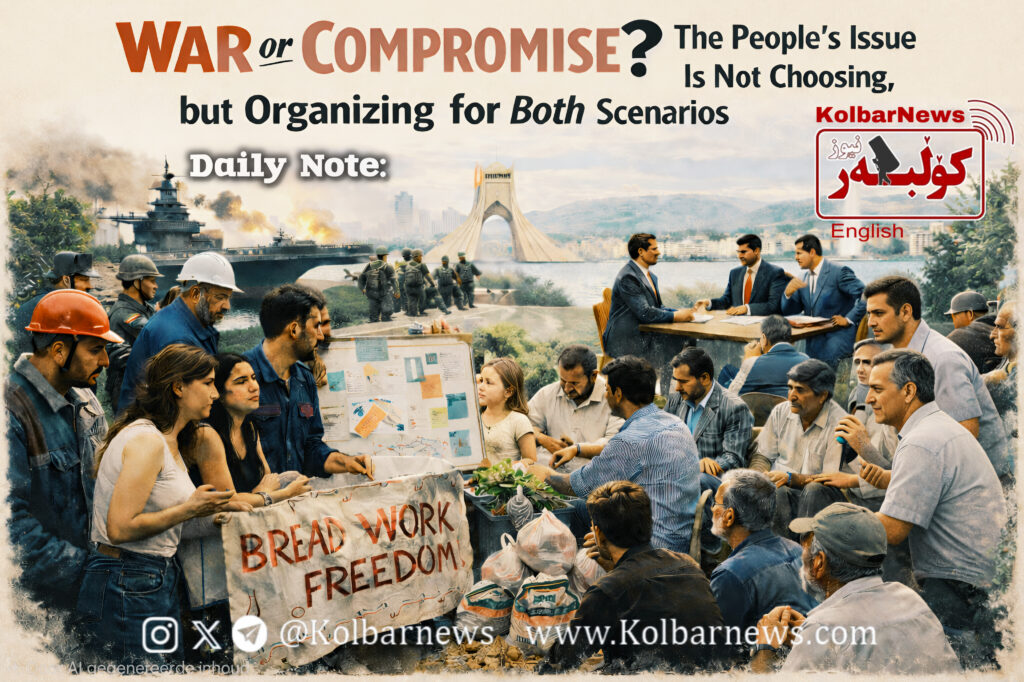
On the other hand, Marco Rubio, the U.S. Secretary of State, while expressing a preference for diplomacy, has emphasized that “no one has been able” to reach a successful agreement with Iran. At the same time, the United States has deployed a second aircraft carrier to the region and is preparing for the possibility of a “long-term military campaign,” as they describe it, if the talks fail. In addition to military pressure, according to Axios, Trump and Netanyahu have agreed to try to reduce Iran’s oil exports to China, an action that could significantly reduce Tehran’s oil revenues.
These developments show that both sides are simultaneously maintaining the path of diplomacy and the leverage of pressure, a combination that could steer the talks either toward agreement or toward escalation.
Under such conditions, the main question for the majority of people in Iran is not “supporting or opposing” one scenario or the other.
The people are neither decision-makers of war nor the owners of compromise. What is decisive is readiness to confront the consequences of both scenarios and to build an independent force from below; a force capable, in moments of political opening or collapse, of both protecting everyday life and ensuring that the struggle against the Islamic Republic does not retreat.
If an agreement occurs, such a peace will likely not bring freedom or the fulfillment of the people’s basic rights. The experience of the JCPOA is still fresh. The release of more than $150 billion in Islamic Republic assets not only failed to improve the living conditions of the working class and the lower strata of society, but also deepened class inequality, expanded corruption, and strengthened the regime’s security and military capabilities.
Increased oil revenues or access to foreign capital may, instead of public welfare, be spent on expanding security, surveillance, and repression capacities. One could imagine that a relative reduction in security pressure might create some space for civil, labor, student, and women’s organizing. But this space is always conditional on security calculations and can be withdrawn.
The serious danger of an agreement is not only the continuation of the regime, but its transformation into a form more acceptable to the United States and more tolerable to parts of society, a situation that could temporarily reduce the majority’s motivation for fundamental change and burn the opportunity for its revolutionary overthrow. Although an agreement could increase the capacities of social movements, it would simultaneously strengthen the Islamic Republic’s survival mechanisms.
But war, even a limited one, imposes its own logic on society. Everything becomes securitized.
The IRGC and intelligence institutions take control of society, and any protest is labeled “treason.” “Defense of the homeland” becomes a pretext for closing public political space, suspending basic rights, and intensifying repression. Any dissenting voice can easily be targeted with accusations. War brings higher inflation, collapse of public services, unemployment, and hunger. War means hospitals, schools, water, electricity, and housing are at risk of collapse; waves of migration and homelessness tear apart social bonds.
It is conceivable that such a situation could lead to large uprisings, but without organized networks and leadership, the outcome of such uprisings could be uncertain, costly, and even benefit reactionary forces.
War can open fractures within the ruling system but fractures at the top become opportunities at the bottom only when popular institutions exist to fill the power vacuum. Otherwise, fractures turn into competition among armed factions and bargaining over the people’s future.
The danger of war includes the emergence of warlords, extremist groups, and direct intervention by regional and international actors. The danger of war is the “Libyanization” of Iranian society. Even if the Islamic Republic is weakened or defeated, it may survive in a weaker yet more securitized form, while simultaneously subjecting Iran to a humanitarian catastrophe.
The reality is that for the majority of society, neither scenario is a choice. Both are costly in different ways. In agreement, the main danger is the continuation and reproduction of the regime with a different face and greater access to resources.
In war, the main danger is humanitarian disaster, power vacuum, and the transformation of Iran into a geopolitical battleground. In both cases, if an independent social force does not emerge, people will be crushed under circumstances they did not choose.
So what is the solution? The solution, as we have emphasized repeatedly, is organizing from below and filling the power vacuum with people-based governing institutions.
The key to the success of social movements lies not in betting on the outcome of negotiations or war, but in building the capacity to administer society from below that is, creating networks and institutions capable, in moments of opening or collapse, of defending people’s daily lives and providing bread, medicine, and neighborhood security.
This means creating councils and general assemblies in workplaces and living spaces; workers’ councils in factories, services, transportation, oil and gas; local assemblies in neighborhoods and cities; and building mutual aid networks and solidarity funds.
The harsh reality is that if people do not fill the power vacuum, sections of the IRGC, regime reformists, or foreign forces and warlords will fill it. But what should be done now, while neither scenario has yet occurred?
Starting today, and continuing the current social movements, demands under the slogan “Bread, Work, Freedom” must be connected. If economic demands are separated from freedom, they become bargaining tools for factions within the regime or the right-wing bourgeois opposition. If freedom is separated from bread, slogans lose their material foundation. The left must link these two in real organizing.
What will happen in the Geneva negotiations ‘whether agreement or war’ will not be the final determinant of the people’s fate. If the left wants to become a decisive force at critical moments, it must, starting now, move beyond merely interpreting events at the top and instead build power from below. In the face of both scenarios, the answer is the same: organizing from below, class solidarity, and people-based governance to fill any power vacuum for freedom, equality, and a better life.