
The war that began early Saturday morning with coordinated U.S. and Israeli attacks on Iranian territory entered a new and far more complex phase on Monday, March 2, 2026. Israel announced that it had launched a new wave of airstrikes against Tehran, with its stated objective being “control of the skies” and opening an operational path to Iran’s capital. At the same time in Tehran, the ruling establishment, in response to the vacuum created by the leader’s death, announced the formation of a temporary mechanism to manage leadership affairs, while exchanges of fire between Iran and Israel continued uninterrupted. The consequences have extended to the Persian Gulf, energy routes, international flights, and even the streets of Pakistan and Iraq.
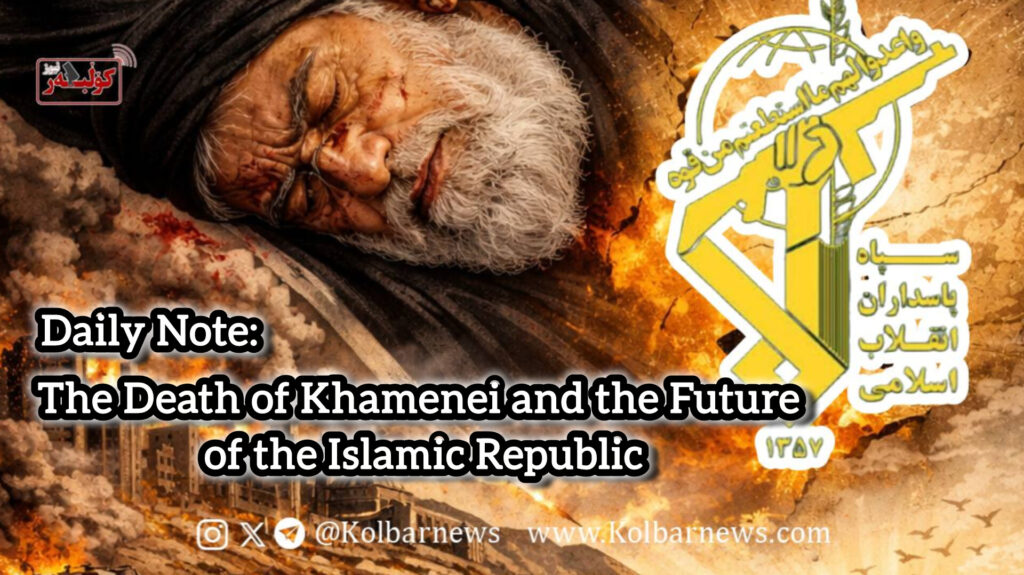
Although Khamenei’s death represents a heavy and unprecedented blow to the Islamic Republic, it does not in itself mean the end of the system. Over 47 years, the Islamic Republic has demonstrated that its security, ideological, and economic structures function beyond any single individual. However, this event undoubtedly delivers a severe and destabilizing blow not only to this regime but also to the broader current of political Islam across the region. From Hezbollah in Lebanon to affiliated groups in Iraq and Yemen, all of these movements have, in various ways, drawn support from Tehran, with Khamenei serving as their ideological and political symbol. With the fall of this symbol, the scope of the crisis extends beyond Iran’s borders.
Under current conditions, the future leadership of the Islamic Republic will not be determined without the decisive role of the Islamic Revolutionary Guard Corps (IRGC). Yet the IRGC itself is not a unified structure. It consists of two distinct but intertwined components: military forces engaged in combat, and a powerful financial oligarchy that controls a significant portion of Iran’s economy. The heavy losses suffered by the IRGC during this war have disrupted the balance between these two components. The military wing, consumed and weakened by battlefield engagements, has lost its capacity for political leadership, creating a vacuum that strengthens the economic wing.
However, if this internal division deepens during the critical moment of power transfer, a scenario that might appear to guarantee stability could instead trigger an internal power struggle. Military rule, amid external war and internal crisis, will not be capable of ensuring the regime’s internal stability.
Over three decades of leadership, Khamenei had assumed a role beyond ideological authority. He became the point of connection among competing factions and vested interests within the system. He functioned as mediator among parallel institutions, arbiter of factional disputes, and guarantor of relative stability within the mafia-like networks that had developed under his leadership. This balancing role has disappeared with his death.
The reality is that this vacuum has emerged while war continues. The deaths of high-ranking regime leaders amid direct military confrontation have shattered the system’s internal stability. A regime already in crisis now finds itself in the midst of war without its supreme commander.
To this must be added intensified economic pressure. Years of sanctions, structural mismanagement, and now the massive costs of war have pushed Iran’s economy to a point from which returning to previous conditions is no longer possible. People are burdened by inflation, unemployment, and shortages of fuel, water, electricity, and medical services. Even if the regime survives the military crisis, it will no longer be able to govern as it once did.
The people of Iran are deeply alienated from this system, and this alienation has turned into suppressed anger. However, the distance between alienation and overthrow can only be bridged by organization and preparedness, and in this regard Iranian society still faces serious divisions. Protest movements have been fragmented, no widely accepted leadership has emerged, and forces for change have not yet developed the capacity to assume power.
If the Islamic Republic survives this crisis as a political system, the issue of succession will become the central struggle within the regime in the coming weeks and months. Under the constitution, the Assembly of Experts is tasked with selecting the new leader, but in a system where real power is determined by force and financial influence, this legal structure serves largely as a formal cover. What happens behind the scenes will be bargaining among the military and economic factions of the IRGC, conservative clergy, and technocrats close to the government, each calculating its own survival.
Amid these developments, the central issue from the perspective of workers, laborers, and oppressed people is this: whatever happens at the top will create both new opportunities and new dangers.
Periods of transition are always both a window for transformation and a field for the reproduction of authoritarianism in new forms. If progressive forces in society do not fill this power vacuum, authoritarian forces will fill it instead.
Khamenei’s death has brought down one pillar of the Islamic Republic, but other pillars remain standing. What will determine Iran’s future is not only the weakness of the system, but also the strength and readiness of those who seek to build a different future. The effort to achieve that readiness is the central task of this moment in which we live.