

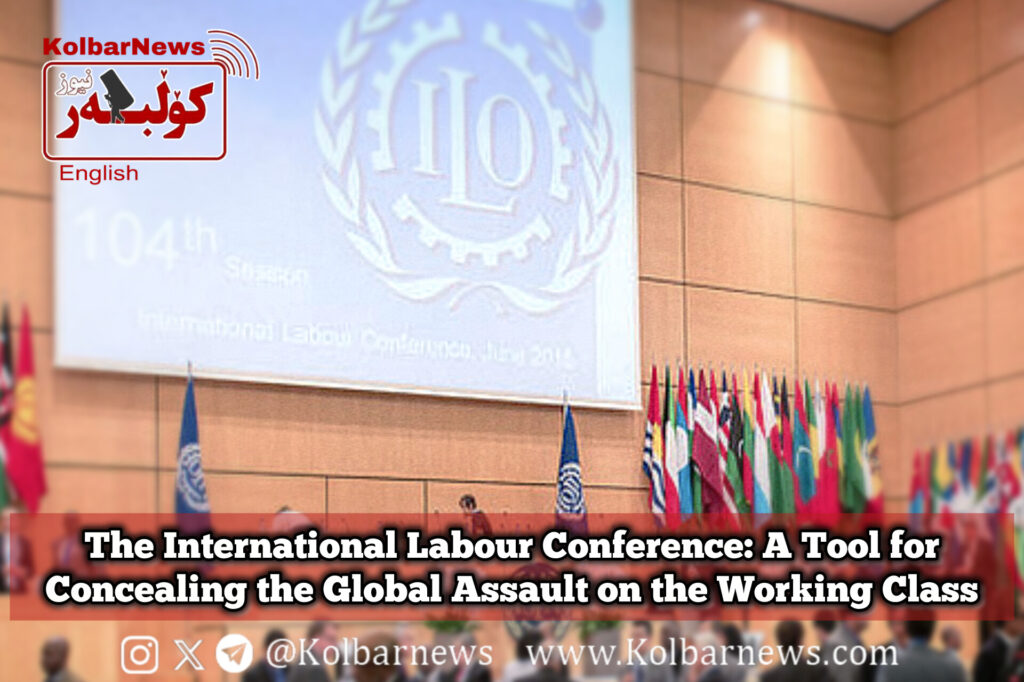
The 114th annual session of the International Labour Organization (ILO) is once again being held in Geneva, Switzerland, the capital of global diplomacy. As in previous years, this conference serves as a stage where representatives of governments, employers, and “workers’ representatives” gather ostensibly to seek solutions for improving labor conditions around the world. Yet behind this deceptive appearance and the so-called “tripartite” structure lies another reality: these conferences not only fail to resolve the endless problems faced by the working class, but have themselves become instruments for legitimizing the systematic assault of capital against labor.
The constitution of the International Labour Organization is founded upon a principle called “tripartism,” according to which workers’ representatives stand alongside representatives of governments and employers. From the outset, this arrangement reflects a legal inequality. Within this formula, workers’ representatives always remain in an absolute minority and possess no real power to advance their demands against the united bloc of governments (as guardians of the capitalist order) and employers (as owners of capital). Even if we assume that those participating in the conference genuinely represent independent workers’ organizations “which in many cases they do not” this predetermined structure neutralizes any attempt to achieve fundamental change. At best, the conference results in ineffective resolutions and conventions whose implementation is ultimately left to the will of the very governments that are themselves primarily responsible for anti-worker conditions.
This conference is taking place at a time when the working class across the globe is under unprecedented pressure. Capitalist governments “from the most “democratic” states in the West to the most brutal dictatorships in the East” are engaged in relentless competition to maximize profits by continuously rewriting labor laws against the interests of workers. Welfare and social services, themselves the product of decades of bloody workers’ struggles, are being dismantled under the pretext of economic austerity. Retirement ages are raised, pensions reduced, and job security has become an unattainable dream. Temporary and blank-signature contracts deprive workers of their most basic rights, while the reserve army of the unemployed grows larger by the day. Poverty, the diseases resulting from it, and social harms such as addiction and suicide are direct products of this exploitative system. Under such conditions, nothing beneficial for the working class can emerge from a conference where representatives of these same governments and employers stand hand in hand.
The situation for workers in Iran, however, is far more catastrophic. In Iran’s case, the issue is not merely that workers’ representatives are in the minority; the issue is that those attending the conference under the title of “workers’ representatives of Iran” bear no relation whatsoever to the working class and are themselves part of the apparatus of repression and control directed against it. These individuals are handpicked agents of security and state institutions drawn from yellow and government-controlled organizations such as the “Workers’ House” and the “Islamic Labour Councils.”
The record of these so-called representatives is marked by professional strikebreaking, the fabrication of cases against independent labor activists, and the role of provocateurs aimed at derailing workers’ protests. These are the same people who, within the sessions of the “Supreme Labour Council,” act as accomplices of the state and employers by imposing wages far below the poverty line upon millions of Iranian workers and legalizing slave-like temporary contracts through their signatures. They embody betrayal of the working class and symbolize collaboration with its class enemy.
Even more shameful than the presence of these agents in Geneva is the conduct of the International Labour Organization in accepting them. While labor federations and trade unions around the world have repeatedly condemned the Islamic Republic for its brutal repression of workers, imprisonment of labor activists, and systematic violation of the ILO’s own fundamental conventions, the organization continues each year to roll out the red carpet for this government delegation with complete disregard for international protests. This act amounts to nothing less than complicity with a regime whose hostility toward workers’ fundamental rights is evident to all. Through this conduct, the International Labour Organization not only legitimizes repression in Iran but also turns the very concept of “workers’ representation” into a mockery.
For militant workers in Iran and socialist activists, these conferences possess no legitimacy. The path to the liberation of the working class does not pass through the luxurious halls of Geneva or lobbying with international bureaucrats, but through independent organization, nationwide strikes, and relentless struggle on the factory floor and in the streets. Only by relying upon our own organized power can we shatter this oppressive order.