

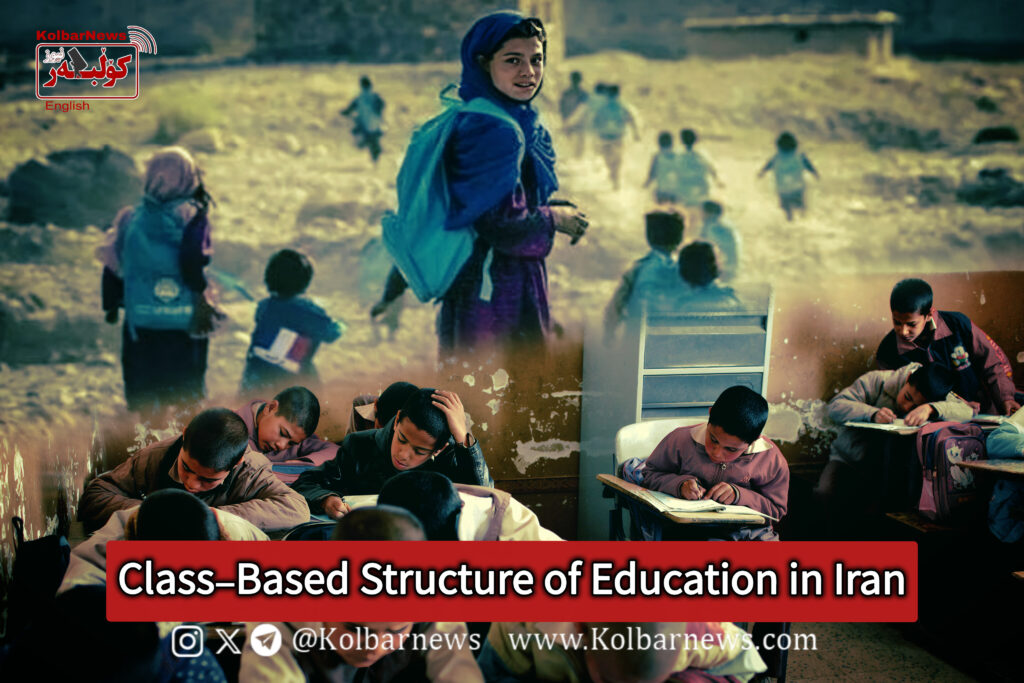
The educational system of any country not only shapes the future of younger generations but also acts as a mirror reflecting the social and class structure of society. Examining the results of this year’s nationwide university entrance exam in Iran reveals a shocking picture of the depth of class inequality in Iran’s educational system. The statistics of this year’s exam are a bitter reflection of the real situation of education in Iran. According to reports published in Iranian media, this year’s exam was held with about half a million participants. The announced results indicate deep class inequality in the published outcomes. Iran’s educational system under the rule of the Islamic Republic is based on four types of schools, each offering different levels of facilities and opportunities to students:
First, private Sampad schools, which is short for the National Organization for the Development of Exceptional Talents, are at the top of the educational hierarchy. These schools, with superior facilities, experienced teachers, and advanced teaching methods, provide an ideal environment for nurturing talents.
Second, private non-profit schools, which, although ranked second, still offer significantly better facilities and educational quality compared to public schools.
Third, public model schools that attempt to provide a higher quality education than regular schools but face budgetary limitations.
Fourth, regular public schools, which accommodate more than 70 percent of the country’s students and have the least facilities and opportunities.
The published statistics show the distribution of top exam ranks among these four types of schools as follows:
78 percent of top ranks are from private Sampad schools, 10 percent from private non-profit schools, 8 percent from public model schools, and zero percent from regular public schools, which accommodate more than 70 percent of students nationwide. These statistics demonstrate the deep class inequality in the Islamic Republic’s education system. This clearly shows that regular public schools, which make up the overwhelming majority of students in the country, did not produce even a single top-ranking student. In addition to class inequality, the geographical gap is also evident in the exam results. Khuzestan Province, with more than one million students, accounts for only 5 percent of the country’s top ranks. This is while the total number of participants in the exam was 500,000, which shows the depth of inequality between developed and deprived regions.
It is clear that the path to educational success in Iran is mostly paved by wealth and access to special schools (Sampad and private non-profit), not by fairness and equal opportunities. Talented students from deprived areas and public schools, even with their abilities, do not have the chance to achieve their rightful place. This situation arises from the fact that Iran’s education budget accounts for about 10 percent of the total national budget. The massive difference in talent development reflected so clearly in exams like this comes from this very reality. Private and Sampad schools, by charging high tuition fees and receiving special support, are able to provide better educational services, hire more experienced teachers, and use modern equipment. In contrast, regular public schools struggle with a lack of facilities, overcrowded classrooms, and the absence of suitable equipment.
It is evident that this situation deepens the class divide in society. Students from wealthy families who can afford the tuition fees of private schools have better opportunities to enter prestigious universities and, as a result, access better jobs.
When there is no investment in public educational infrastructure, when schools are not equipped with tools and educational aids, when the number of students in a classroom is two to three times its capacity, when a teacher exhausted from working a second job at night to make ends meet comes to class tired and worn out, when they don’t even receive their meager salaries on time, what better outcome than what we saw in this year’s nationwide exam can be expected?
There are many talents in deprived areas and public schools that, due to the lack of proper facilities, are not given the chance to flourish. When students in public schools see that, despite their efforts, they cannot compete fairly, their motivation to study decreases and a sense of hopelessness develops in them. The rising number of students dropping out of school stems from this very reality. In addition, teaching methods in public schools are unscientific and disconnected from modern educational achievements.
In these public schools, due to the high density of students in classrooms, lack of sufficient time, and the absence of laboratories, workshops, and educational aids, the teacher becomes the sole center of all education. Such methods deprive students of opportunities for group research, discussion, and participation in various areas, forcing them to demonstrate their abilities through rote memorization of whatever the teacher says.
Furthermore, in Iran’s public schools, little serious attention is paid to sports and physical development and their constructive role for children and teenagers. Children and adolescents, due to the lack of proper spaces in cities and villages and because of living in apartments and small, crowded houses, do not have a place to exercise and play. The cramped spaces of schools also do not provide such opportunities for students.
Overcoming this disastrous state of education in Iran is only possible through the mobilization of the immense force of students and university students, teachers and professors, and by linking their struggles with the struggles of workers and other protesting sectors of society. This solidarity can not only neutralize the Islamic Republic’s policies of suppressing the talents and capabilities of Iran’s youth but also pave the way for freeing Iranian society from the grip of the ruling Islamic reactionary system.