

Writer: Roman Miraki
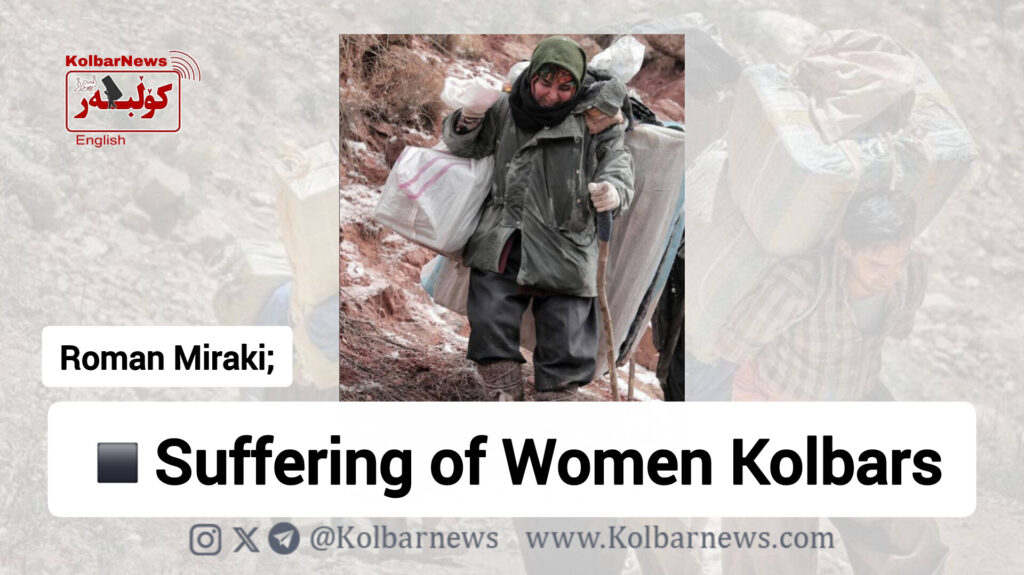
This report presents several true stories from women Kolbars from five Kurdish regions of Iran, whose lives were examined in an ethnographic study.
“One of the women Kolbars I spoke to was 47 years old, both she and her husband were Kolbars, and she had broken her leg on the way and didn’t even have money for her surgery. She would get 100 thousand tomans for each item she carried, and the weight of the load made no difference in her wages. Another woman was 55 years old, had three unemployed and educated sons, and her husband worked in a shop next to her. They have a shop where, in addition to supermarket products, they sell items that bring from Iraq. Another woman said that she had started Kolbari since the Iran-Iraq war, had five children, and had lost her husband.”
These are some true stories from women Kolbars in five Kurdish regions of Iran whose lives have been studied in an ethnographic study; women who do not contribute much to research and whose political and social identity is difficult to obtain.
One of the studies that focused on the issue of women Kolbars and more details about “Kolbars at the Intersection of Ethnicity, Gender, and Class.”In my observations, I have obtained a new narrative of the living conditions of women Kolbars and their living environment. In my research, I have obtained more details about the type of exchanges of women Kolbars, according to which a type of daily exchange takes place in these borders, which has three types: one is the transfer of goods with Kolbars, another type is with animals, and the third type is with passenger cars or trucks. In this study, there were women Kolbars, warehouse workers, and those who transfer goods with working machines.
A sense of shared identity
What context exists on the western borders that provides the basis for Kolbari ? Studies show that before the strict border policies between Iran, Iraq and Iraqi Kurdistan took place, its residents considered each other as a single geography due to their common language, identity and religion. During the Iran -Iraq war, many people were displaced due to displacement and war between these two countries, family and friendship ties were formed. Being a common language and being Kurdish had made them deepen and consider themselves part of the single geography of Kurdistan.
Kolbari since the age of 15
One of the women interviewed in this study was 68 years old and had nine children. Due to her poor living conditions, she had chosen to start Kolbari. Two of her daughters accompanied her on this way, one of whom does Kolbari with her on snowy roads when she had a new born. Her other daughter had been a Kolbar on this road for four years since she was 15. There were other 15 years old girls who do Kolbari with their mother.
This woman had six times leg surgery, had a herniated disc, and had other illnesses due to Kolbari. In the last few years, she had given up Kolbari and started working as a warehouse worker with several other women. Iraqi women who had come to Iran during the war and were displaced also does Kolbari with them: “Two themes can be drawn from these narratives: one is that this phenomenon causes a lot of physical pain for these women, and the second theme is that many of the goods that Kolbars bring are not for trade and are not considered commercial goods; goods such as bread, food, and raw materials. It is the Iraqi people who tell Kolbars to bring local soup or vegetables and other raw materials to this region; because these items are of higher quality in Iranian Kurdistan than in Iraqi Kurdistan and cost them less. The transportation of food has also been different in different time periods.”
The women interviewed in this study had experienced various forms of inferiority. They were from a lower economic class, their husband had either died or were ill, or both their husband and children were unemployed, and they were the heads of the household while working at home: “Another part of their inferiority was their ethnic and religious minority status; these women had low levels of education or were completely illiterate, but they tried to educate their children, and at the same time they had something in common”.
These women had no entertainment or entertainment in the villages and could not even use public spaces, because these spaces were completely manly. The women interviewed in this study take refuge in Kolbari to get away from the walls of their homes. One of them explained that if the border was open now, maybe we would not stay at home so long to think and dream. These women suffered a lot, but they believed that Kolbari was much better than begging. They had no support from their families and the government and were forced to work themselves and wear so called pantol or men’s trousers. “These women wear men’s Kurdish trousers, but in practice they earn less money. For men, it is considered a kilo, but for women, it is considered a burden.”
Kolbars: The lowest stratum of the working class
The other side of the story of Kolbari in Iran is the economic relations in the Iraqi Kurdistan Region, which became an autonomous region in 1990, had an independent economic program, and is economically subject to the decisions of the World Bank and the International Monetary Fund. This process ultimately led to the formation of financial capitalism in this region, and is now considered a beneficiary in the process of transferring goods to Iran. According to economic experts, the Kurdistan Regional Government is in the category of rentier states that use and distribute oil money and do not invest in the fields of industry, construction, agriculture, and even animal husbandry, which have potential.
In the past few decades, capitalist relations have encompassed all aspects of our lives, we have suffered from uneven growth, uneven underdevelopment has been created, and we need a visible hand and government intervention to prevent the invisible hand of the market. The provinces of Sistan and Baluchestan and then Kurdistan province are in low ranks in terms of per capita GDP and development at the lowest levels, and in many provincial indicators like South Khorasan, North Khorasan, West Azerbaijan, and several other provinces are in inappropriate conditions: “If this issue is left to the market economy, which looks at financial profitability, investment in these areas usually has lower returns and higher risks, so it does not go to these areas; therefore, there is a need for government intervention here, but which government ? Has such a will existed in Iranian governments even in the last century?”
One aspect of Kolbari in Iran is the Kurdistan Region, from where goods enter our economy: “If we consider the economic relations between Iran and the Kurdistan Region of Iraq and the profits that are made in terms of transporting goods across the border, a commercial and indigenous bourgeoisie has formed in the Kurdistan Region. The Kurdistan Region’s economy lacks investment, has a high unemployment rate and part time work, and in these conditions, it has few economic opportunities, and the development of Kolbari has many stakeholders in this region.”
Kolbars are the lowest strata of the Iranian working class. Kolbari are a class issue and should not be reduced to an ethnic issue. This issue is intertwined with patriarchal, class, and ethnic oppression. In my opinion, if we look at Kolbars from the perspective of political economy and power relations in the economy, we should first focus on the more general developments that the Iranian economy has undergone in recent decades, the most important of which is the transition to a capitalist economy, which occurred about 100 years ago during the land reform period, and in the last four decades and after the war, these capitalist relations have deepened and grown further. In terms of per capita GDP, development is at the lowest levels among the provinces, and at the bottom of the table is Sistan and Baluchestan Province, followed by Kurdistan Province, and other provinces such as South Khorasan, North Khorasan, West Azerbaijan, etc. also have inadequate conditions.
The connection between the lives of women Kolbars and the border
The lives of women Kolbars are linked to the border, and since they remember that the job of a family member was linked to the border, Kolbari has become their family job, and a repeating cycle is taking place. Many of them have chosen Kolbari as their second job; the connection with the border also affects their emotions. One of these women said: “Every day they tell me there is no border, my heart stops.”
Excluding women Kolbars from research
In the research published to date on the Kolbari issue, two characteristics should be examined: “In these studies, we are faced with the exclusion of women, and on the other hand, an exotic and strange image of them is presented; that is, when we talk about women Kolbars, it is as if we have opened the doors to the sorrows of the world and are supposed to present an image that will be interesting to the media. It is important not to fall into the trap of this story that this research goes through.”
My research on women Kolbars, emphasizes the recognition of women Kolbars as subject with political and social identities and believe that the issue of women Kolbars is an intersection of the simultaneous effects of gender, ethnicity, and social class: “We have a context where all kinds of contexts that give us multiple identities and can dominate us are applied in a single body. If one group of women or individuals in society always has a louder voice and the possibility of discourse and media, they may become representatives of the rest of the groups, which causes the experience of other groups to be marginalized. Kurdish women Kolbars live in conditions where all different types of oppression can overlap and interact with each other to a great extent, creating difficult conditions for the individual.”