
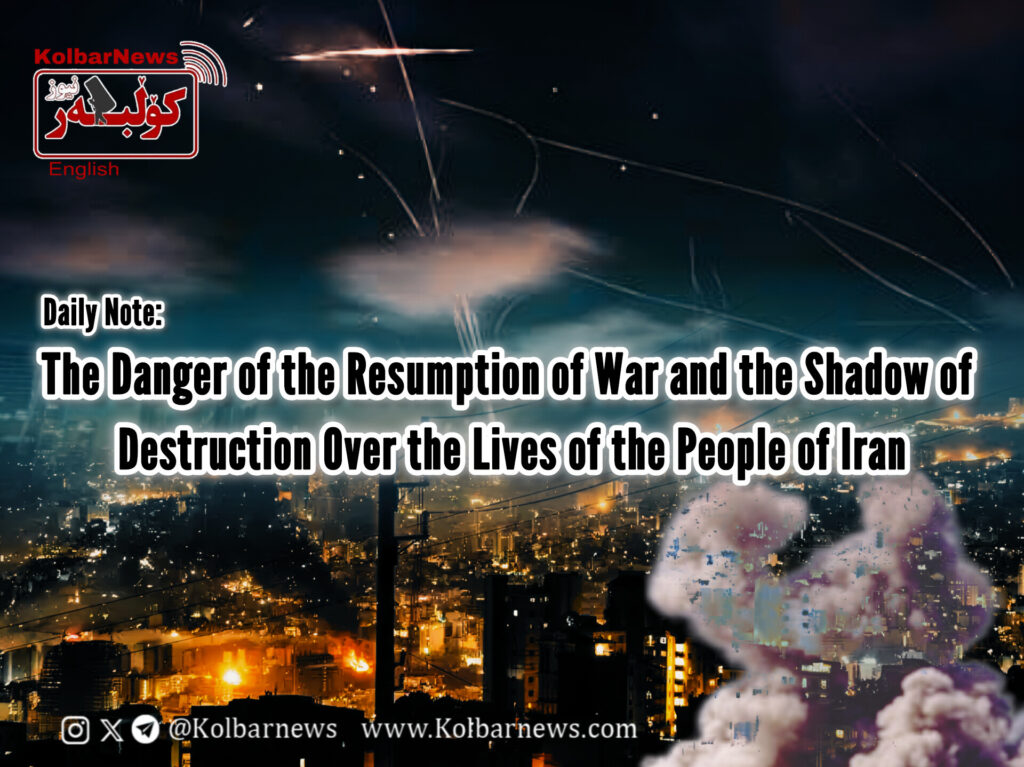
The deadlock in negotiations between the United States and the Islamic Republic, mediated by Pakistan, has once again turned the possibility of war into one of the most serious concerns for Iranian society and the region. Reports published in recent days, including a report by The New York Times citing several officials in the Middle East, speak of the possibility of renewed conflict. At the same time, Israeli officials have also announced that they are preparing for a new round of war. These warnings cannot merely be regarded as propaganda threats or part of psychological warfare. The experience of recent years has shown that whenever diplomacy reaches a deadlock and the main actors return to the language of threats, the danger of war increases.
What makes the current situation more dangerous this time is not only the possibility of military attack, but also the nature of the attack being discussed. Recent reports regarding the preparedness of the United States and Israel for possible attacks speak of the “heavy bombardment of infrastructure.” Infrastructure means electricity, water, refineries, telecommunications, bridges, roads, hospitals, transportation networks, fuel depots, and communication centers. In simpler terms, infrastructure means the pillars upon which the daily lives of ninety million people rest. Therefore, if such a war begins, the ordinary lives of the people of Iran will be directly targeted by its consequences.
The first and most immediate consequence of attacks on Iran’s infrastructure would be the collapse or severe disruption of the electricity network. Iran has for years faced electricity shortages, a deteriorating power grid, reduced investment, and repeated blackouts. In many cities, several hours of power outages have become routine. Now, if power plants, substations, and transmission lines are targeted, a catastrophe in the truest sense of the word would occur. Dialysis machines would stop working, operating rooms would shut down, oxygen supply systems would be disrupted, and refrigerators used to store vital medicines, including insulin and vaccines, would go out of service.
The experiences of Iraq in 1991, Yugoslavia in 1999, and Lebanon in 2006 have shown that an attack on the electricity network is an attack on social life itself. Under such conditions, indirect deaths sometimes exceed the direct victims of bombardment. A child who dies in a hospital due to lack of electricity, a patient whose medicine spoils, or an elderly person left without facilities in extreme heat or cold are all victims of war, even if their names never appear in official casualty statistics.
The water crisis would also immediately follow the electricity crisis. Iran is a semi-arid country, and in many regions the supply of drinking water depends on pumping stations, treatment facilities, dams, and transmission networks, all of which themselves depend on electricity. The collapse of these networks means shortages of drinking water, the spread of infectious diseases, disruption of public hygiene, and increased pressure on the healthcare system. In large cities, prolonged water cuts could turn into a humanitarian disaster.
This crisis would occur under conditions in which long-term sanctions have already weakened Iran’s medical reserves, healthcare equipment, and reconstruction capacity. Many hospitals already face shortages of medicine, worn-out equipment, the emigration of medical staff, and budget deficits. War would place such a system not merely under pressure, but on the verge of collapse.
Attacks on refineries and oil infrastructure would also have consequences extending far beyond the military field. Despite all claims about reducing dependence on oil, Iran’s economy still relies heavily on oil and energy revenues. If refineries, export terminals, fuel transmission lines, or gas facilities are targeted, state revenues, already limited and exhausted, could sharply decline or in some sectors come to a halt. The result would be a reduced capacity to import essential goods, fuel shortages, disruptions in transportation, rising food prices, and intensified inflation. In a country where people are already struggling with the soaring prices of bread, meat, chicken, eggs, dairy products, and medicine, war could push the lives of millions to the edge of hunger and desperation.
The regional dimensions of war are also alarming. In reports published about the 40-day war, there has been mention of the participation or support of Saudi Arabia and the United Arab Emirates in the bombardment of Islamic Republic positions. If, in a new round of conflict, the Islamic Republic launches missiles toward these countries, they too, as they have warned, would likely respond. In such a case, the war could move beyond a confrontation between Iran, the United States, and Israel and turn into a broader regional conflict.
Historical examples in this regard are numerous: Iraq after the 2003 war, despite the extensive presence of the international community and billions of dollars in spending, remained engaged in rebuilding its basic infrastructure for more than two decades and still carries the effects of that war. Libya after 2011 continues to suffer from instability, institutional collapse, and competition among armed groups. The experience of these countries shows that the destruction of infrastructure can occur within a few weeks, but rebuilding it may take an entire generation. Certainly, Iran under the rule of the Islamic Republic, with a sanctioned economy, a closed political structure, widespread corruption, and deep social divisions, will not be able to quickly rise from the rubble after a devastating war. The people lose from both sides: the regime remains in power while people’s lives are destroyed.
In the face of such a catastrophe, silence and passivity are dangerous. The international peace movement must actively pressure all sides to abandon maximalist policies, military threats, and excessive demands, and to take diplomatic solutions seriously. Preventing war does not mean defending the Islamic Republic; just as opposing the Islamic Republic should not turn into support for the bombing of Iran. It is possible and necessary to simultaneously oppose the repression, adventurism, and destructive policies of the Iranian government while also standing against war. The victims of both are the people of Iran.
The people of Iran, too, should not remain passive observers of a catastrophe that this time would directly target the foundations of their lives. A war that destroys infrastructure does not merely weaken the government; it wounds society, impoverishes it, sickens it, and robs it of its future. A hospital that is bombed or left without electricity does not belong to the government; it belongs to the people. A water network that collapses cuts off water to people’s homes. A refinery that burns imposes inflation, unemployment, and shortages upon people’s lives.
The solution is an immediate return to diplomacy, the cessation of military threats, the signing of an agreement to prevent war, and organized public pressure against all parties dragging the country toward the abyss. More than ever, the people of Iran need peace, freedom, reconstruction, and life, not another war whose rubble would fall first and foremost upon the people themselves.