
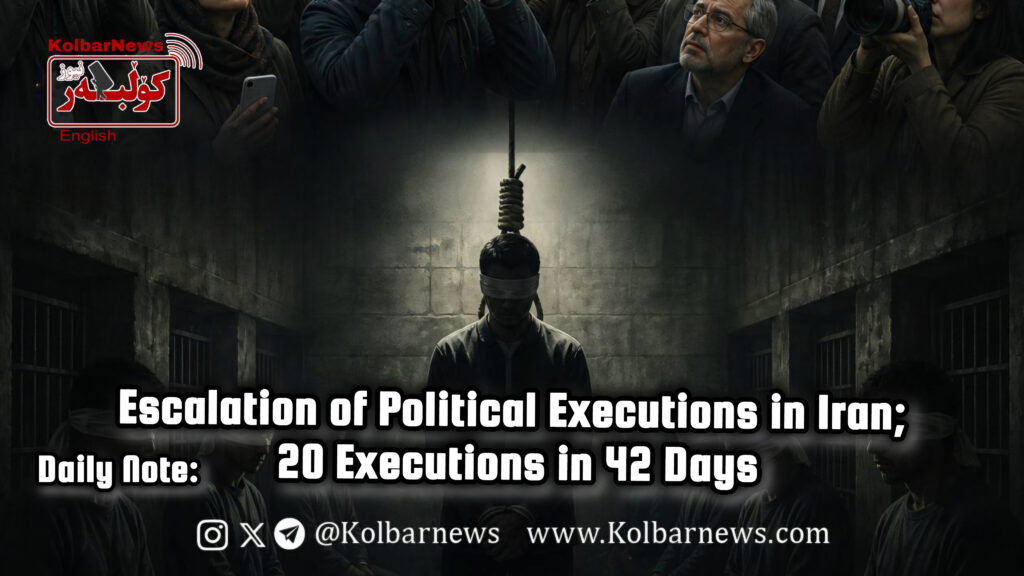
While the war between the United States and Israel and the Islamic Republic, which began on February 28, 2026, has entered its third month and the world’s attention is focused on military and diplomatic developments, the Islamic Republic has, behind the scenes of the war, gone through one of the bloodiest periods of executions of political protesters. In the past 42 days alone, at least 20 political prisoners connected to the January 2026 protests have been hanged, and 44 others are currently on death row.
The executions of arrested protesters began on March 19, 2026. On that day, Saleh Mohammadi, Saeed Davoudi, and Mehdi Ghasemi were executed in Qom Central Prison. On March 30, 2026, Mohammad Taghavi Sangdehi and Akbar Daneshvarkar were hanged. One day later, Babak Alipour and Pouya Ghabadi Bistouni were executed.
On April 2, Amirhossein Hatami was executed. Three days later, his co-defendants, Mohammadamin Biglari and Shahin Vahedparast, were hanged in Ghezel Hesar Prison, and Ali Fahim was executed in the same prison on April 6. Vahid Bani Amerian was also executed on April 4.
Later, Amirali Mirjafari was executed on April 21 and Erfan Kiani on April 25, 2026. Finally, Sasan Azadvar, a 21-year-old Kyokushin karate champion, was executed on April 30 in Isfahan Central Prison (Dastgerd). He was the tenth protester executed in connection with the January protests. The latest victims so far are Yaghoub Karimpour (43 years old) and Naser Bakrzadeh (26 years old), who were executed on the morning of May 2 in Urmia Central Prison. Both had been forced under torture to confess.
Iran Human Rights, in its latest report, has revealed that at least 44 other protesters have been sentenced to death, among them 2 women and 3 teenagers who were under the age of 18 at the time of arrest. The names of some of them are: Mansour Jafari (17 years old), Shahin Soleimani (23 years old), Hossein Ghalebeygi (22 years old), Reza Moazeni (23 years old), Yaser Mokhtari, Moslem Heydari, Ramadan Asadi, Abolfazl Hashemian, Javad Talebpour, Danial Harouni, Mehdi Eskandari, Navid Shirani, Seyedreza Hassanlou, Davoud Aminzadeh, Mobin Soltani, and Pejman Haghighian, all of whom are being held in Isfahan Central Prison.
State media, in an inhumane act, broadcast the forced “confessions” of Mohammad Abbasi (55 years old) and his daughter Fatemeh. Abbasi was sentenced to death by Branch 15 of the Revolutionary Court of Tehran, presided over by Judge Salavati. His daughter, Fatemeh Abbasi, has been sentenced to 25 years in prison.
Abolfazl Salehi Siavashani (51 years old), Shahab Zahdi (38 years old), and Yaser Rajaifar have also been sentenced to death in a case involving seven defendants. Four of the defendants in this case were executed during the recent war.
Three other teenagers, Ehsan Hosseinipour Hessarloo (19 years old), Matin Mohammadi (17 years old), and Erfan Amiri (17 years old), along with Maryam Hadavand, have been sentenced to death. Ehsan’s lawyer, Milad Panahipour, has warned that this case lacks any real evidence and is based solely on confessions extracted under torture.
Gholamhossein Mohseni Ejei, head of the judiciary, has explicitly emphasized the rapid implementation of death sentences. Mahmood Amiry-Moghaddam, director of Iran Human Rights, stated in this regard: “The Islamic Republic has failed to effectively govern the country and meet the basic needs of the people, has lost its legitimacy, and has resorted to repression and creating fear in order to preserve power. The death penalty remains the government’s most powerful tool for creating this fear.”
He added: “By taking advantage of the new espionage law, the Islamic Republic has accelerated the process of carrying out death sentences against protesters. This process is not a judicial procedure, but part of an organized campaign of state violence. The death sentences are the result of deeply unfair trials in which confessions extracted under torture are used instead of credible evidence.”
We strongly condemn these political executions. With each of these executions, the Islamic Republic not only deprives a human being of life, but also displays another sign of its inability to respond to the legitimate demands of the people. Hanging teenagers such as Matin Mohammadi and Erfan Amiri, who were under 18 at the time of arrest, and women such as Maryam Hadavand and Bita Hemmati, is more savage than words can describe.
Our hearts are with the grieving families who have lost their loved ones in this bloody wave: the mother of Sasan Azadvar who was summoned for a final visit, the parents of Saleh Mohammadi, Saeed Davoudi, and Mehdi Ghasemi, the family of Amirali Mirjafari and Erfan Kiani, and all the families whose loved ones were hanged in the prisons of Qom, Isfahan, Ghezel Hesar, and Urmia.
The international community cannot remain silent in the face of these crimes.
Iran Human Rights has rightly called for “the suspension of the death penalty to become one of the main demands in any negotiations with the Islamic Republic.”