
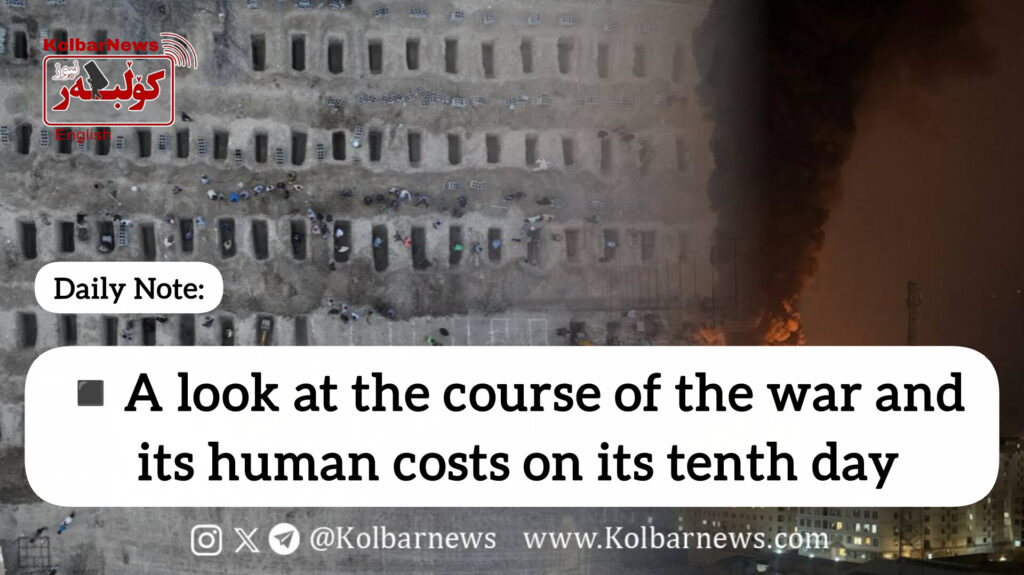
In the early morning of Saturday, 28 February 2026, the United States and Israel launched large-scale airstrikes against several Iranian cities and military centers. Now, on the tenth day of this conflict, a clearer picture has emerged of the positions of the three main actors in this war: the United States and Israel as the initiators of the attack, the Islamic Republic of Iran as the opposing side, and ordinary people in Iran, the region, and the United States who, despite having no role in starting the war, are paying its heaviest price.
Donald Trump described the operation as “large and continuous” in a video message and called on the people of Iran to take control of the government. Benjamin Netanyahu also declared that the goal of the war was the elimination of the existential threat of the Iranian regime. At the official level, three major objectives have been presented for this war: destroying or weakening Iran’s nuclear program, containing its missile program, and ending the Islamic Republic’s support for proxy forces in the region.
However, there is a serious gap between the stated objectives and the reality of war. War, even when carried out with the most advanced technologies and the most precise targeting systems, never remains confined purely to military boundaries. Especially in a country like Iran, where many military centers, Basij headquarters, and police forces are located inside cities and near residential areas, every strike on a military target effectively becomes a direct threat to civilians. People’s homes collapse when these centers are destroyed, and families who have no share in government policies are buried under the rubble.
The unprecedented speed and precision of the U.S. and Israeli attacks are the result of months of planning, concentration of forces, and the use of advanced weapons on a scale not previously seen. Yet this war has become less a scene of eliminating targets and more a scene of wearing down the lives and mental well-being of people.
Technology can increase the accuracy of a missile, but it cannot erase the boundary between a military base and the house attached to it. Artificial intelligence can calculate the path of an attack, but it cannot remove the poisoned air that spreads after the bombing of refineries and fuel depots in cities from the lungs of children, the elderly, and the sick. What in military language is called “collateral damage” is in fact the lives of real human beings: schoolgirls, workers, patients, the elderly, and people whose only “crime” is living near targets chosen by governments for war.
Statements published by Mehdi Mohammadi, a senior advisor to the Speaker of Iran’s parliament, offer a blunt picture of the Islamic Republic’s strategy: expanding the scope of the war and prolonging it. He says this strategy has three stages: attacks on Israel, attacks on U.S. bases in Arab countries, and then expanding attacks to civilian targets such as airports, hotels, and embassies. The attacks on airports and ports in Kuwait, Oman, the UAE, and Azerbaijan, as well as the targeting of the British base in Cyprus, can be understood within this framework.
The logic of this strategy is clear: increasing the cost of the war for the United States by raising human casualties, disrupting the energy market, and intensifying economic pressure, in the hope that eventually the United States will settle for a “symbolic victory” and withdraw from continuing the conflict. For the Islamic Republic, within this logic, survival itself is a kind of victory even if that survival is built on the ruins of cities and the lives of thousands of people. In other words, just as the United States and Israel define their goals in terms of security, the Islamic Republic also places its own survival above any human consideration.
The most bitter and immediate face of this war can be seen in the situation of ordinary people in Iran. One of the most shocking events of these ten days was the publication of images showing a missile striking a girls’ school in Minab, an attack that killed at least 153 young girls. This is not just a “war incident,” but the most condensed image of the anti-people nature of this war. Children who have not voted, issued military orders, or had any role in nuclear programs are suddenly thrown into bloodshed.
But human losses are not limited to those directly killed. Attacks on energy infrastructure, water supply networks, and vital urban facilities have paralyzed the daily lives of millions. Disruptions to drinking water, electricity, fuel, and medical services “especially under wartime conditions” lead to waves of indirect deaths; deaths that may not appear in official bombing statistics but are just as real and catastrophic. Hospitals facing shortages of electricity, medicine, or water place dialysis patients, newborns, people requiring intensive care, and the wounded at risk of death.
The bombing of the Tehran refinery and the spread of thick smoke over the city is another clear example of the indirect but widespread damage of the war. This heavy pollution has placed the lives of thousands of children, elderly people, and those with respiratory or heart diseases in serious danger. In modern wars, death does not occur only through explosions; sometimes it comes through poisoned air, contaminated water, the collapse of urban services, and the constant exhausting anxiety that breaks the psyche of society from within.
Ordinary people in Israel have also not been spared from the human costs of this war. Although Iran has less firepower due to military limitations and the pressure of attacks, the missiles that target cities are still enough to create fear, anxiety, and insecurity among ordinary citizens. Daily life under the sound of sirens, shelters, warnings, and anticipation of attacks is itself a form of human suffering that is no less severe than direct casualties. Children, the elderly, and families who live every day with the anxiety of attack are examples of the human toll of war.
In regional countries as well, attacks on airports, ports, and civilian centers have placed ordinary people directly at risk. Workers in ports, travelers at airports, hotel employees, and residents of targeted cities have all been drawn into a war they neither chose nor have the power to stop.
In the United States, this war is no longer a distant story. Iran’s closure of the Strait of Hormuz has disrupted the global oil and gas market and placed significant economic pressure on global markets and regional allies of the United States. The direct result for people in the United States is rising energy prices and increasing inflation. Working-class and low-income American families, who had no role in shaping Trump’s war policies, must now pay the cost from their own pockets.
At the end of the tenth day, the United States and Israel have military superiority but remain vulnerable to long-term costs; the Islamic Republic, despite heavy blows, continues to rely on the strategy of “prolonging” the war; and ordinary people remain the only victims for whom no one has made room in their calculations.
If each side in the war speaks of victory in its own way, one must ask: victory for whom, and upon the ruins of whose lives? Ultimately, no definition of victory can justify the deaths of children, the destruction of homes, polluted air, the collapse of vital services, and the spread of fear and poverty. In practice, this war is nothing but the expansion of human suffering.