

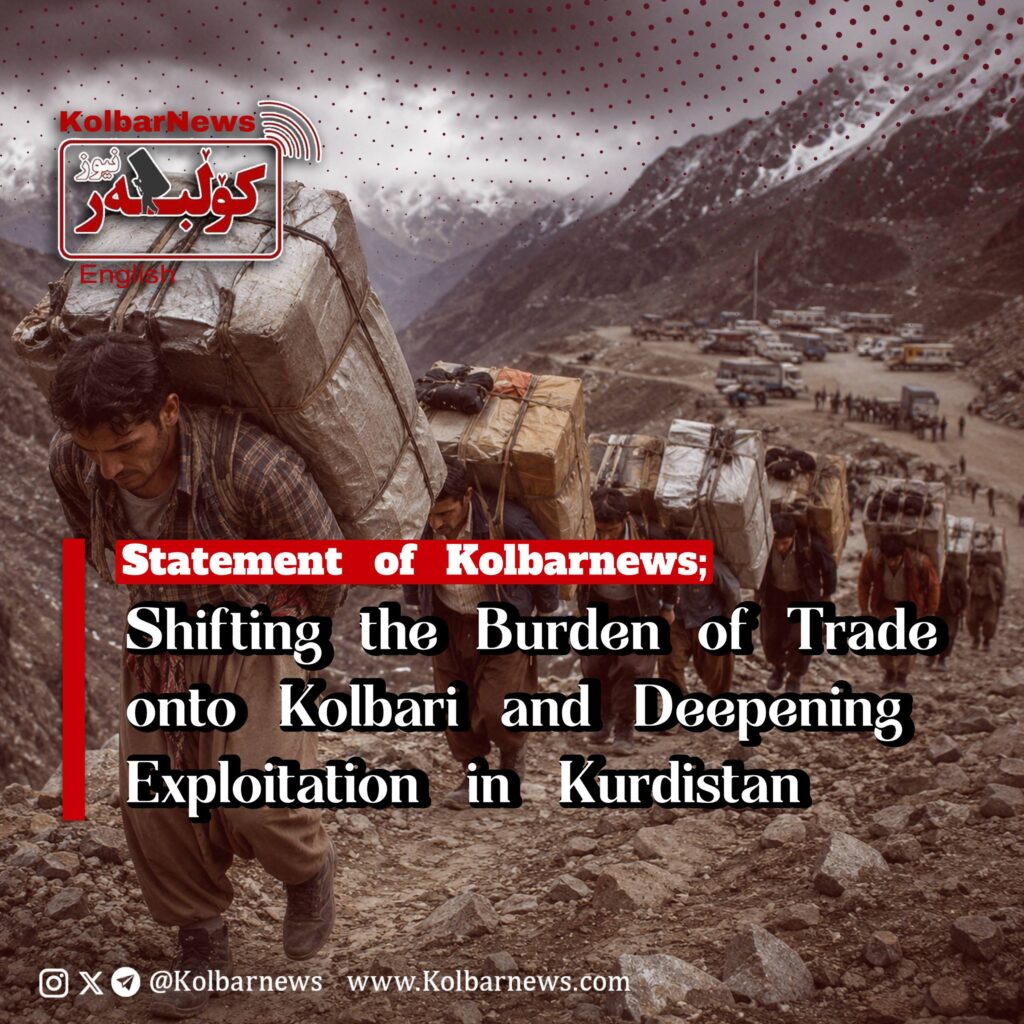
The recent decision by the Islamic Republic to expand the list of goods allowed to enter through Kolbari and maritime trade procedures has, on the surface, been presented under the titles of “organizing border trade” and “supporting border residents’ employment.” However, the timing of this decision alongside the crisis in supplying raw materials, disruptions in official trade routes, export restrictions, and the transfer of part of industrial imports to border routes reveals a reality far beyond an administrative decision. What is today presented in the form of a customs directive, at a deeper level reflects the transfer of part of the costs of economic and structural crises onto the very geographies that for years have borne the burden of deprivation, securitization, and uneven development.
According to the new directive issued by the Customs Administration of the Islamic Republic, the scope of goods permitted to enter through Kolbari and maritime trade procedures has been expanded, and in addition to certain consumer goods, a range of production necessities, industrial equipment, parts, food products, and some raw materials have also been added to the list. At the same time, following shortages of raw materials and disruptions in supply chains, the importation of certain petrochemical and polymer products through these same routes has also been declared permissible.
This decision has been made under conditions in which recent years have been accompanied by war, economic crisis, livelihood pressures, restrictions on foreign trade, and growing social uncertainty, and the government, in order to preserve parts of the supply cycle, has increasingly turned toward alternative routes. But the fundamental question is why, at the moment of crisis, the border and border residents once again become the arena for compensating structural inefficiencies, and why Kurdistan must bear part of the economic crises of the center.
From the perspective of Kolbarnews, kolbari is neither a job nor a free economic choice. Kolbari is a phenomenon born simultaneously from class oppression and national oppression, reproduced within the context of structural deprivation, lack of equal opportunities, concentration of resources, uneven development, and the securitization of the geography of Kurdistan.
Contrary to the official narrative, the kolbar is not someone who has chosen among various employment options. Kolbar is a human being who, as a result of deprivation from the possibility of living with dignity, has turned their body into the final instrument of survival. They have no place in the formal labor market and are deprived of even the most basic economic, social, and legal protections.
For years, Kolbarnews has emphasized the position that defending the Kolbar does not mean defending Kolbari itself. We regard the Kolbar as a victim of imposed conditions, but Kolbari itself as an anti-human phenomenon and the product of unequal relations that must be dismantled. Ending Kolbari does not mean eliminating the kolbar; it means ending the conditions that force human beings to carry loads along border routes in order to secure the most basic necessities of life.
From this perspective, the expansion of imports through Kolbari routes cannot be interpreted as recognition of Kolbars or support for border residents. The transfer of industrial goods and raw materials onto kolbari routes, without creating sustainable employment, without changing the legal status of Kolbars, and without dismantling the structures that produce this situation, means institutionalizing the very mechanism that for years has turned human beings into instruments for compensating crises.
In the analytical narrative of Kolbarnews, Kurdistan is not merely a border region. Kurdistan is a geography in whose historical and political memory the experience of division, domination, deprivation, and national oppression has played a defining role, and which in recent decades, in addition to economic inequality, has continuously faced securitization. This securitization has not been limited only to military presence at the borders, but has also affected the path of development, employment, investment, capital circulation, and the formation of economic infrastructure.
Within such a context, Kolbari cannot simply be regarded as the result of individual poverty. Kolbari is the product of conditions in which parts of Kurdistan, instead of benefiting from sustainable development and equal opportunities, have been pushed to the margins of the economy, and a survival economy has replaced a productive economy.
The human cost of this situation is also evident in the statistics. According to the annual report of Kolbarnews, in 2025 at least 70 kolbars were killed or injured in border areas and intercity routes. Of this number, 32 Kolbars lost their lives and 38 were injured. Based on recorded data, 53 cases, equivalent to 76 percent of all recorded incidents, occurred as a result of direct shootings by military forces. The report also showed that despite a reduction in the total number of victims compared to the previous year, the share of fatalities among total casualties increased from 17 percent to 46 percent; a trend indicating the increasingly deadly nature of Kolbari.
These statistics are not merely numbers. Behind each number stands a human being who had no place within the formal economic structure, yet in moments of crisis their body itself became part of the mechanism of supply and compensation.
Therefore, today’s issue is not simply the entry of several goods through kolbari routes. The issue is that, at a moment of crisis, the same geography that for years has faced deprivation, securitization, and national oppression once again becomes the field onto which costs are transferred.
Kolbari is not a solution. Kolbari is a problem that must come to an end. Defending the kolbar means defending the right to live with dignity, the right to sustainable employment, the right to equal development, and the right to put an end to a mechanism that reduces human beings to mere instruments of carrying loads and bare survival. As long as the conditions reproducing deprivation, inequality, and marginalization remain in place, Kolbari too will continue to be reproduced as one of the starkest forms of exploitation and denial of human dignity in Kurdistan.
Board of Directors of Kolbarnews