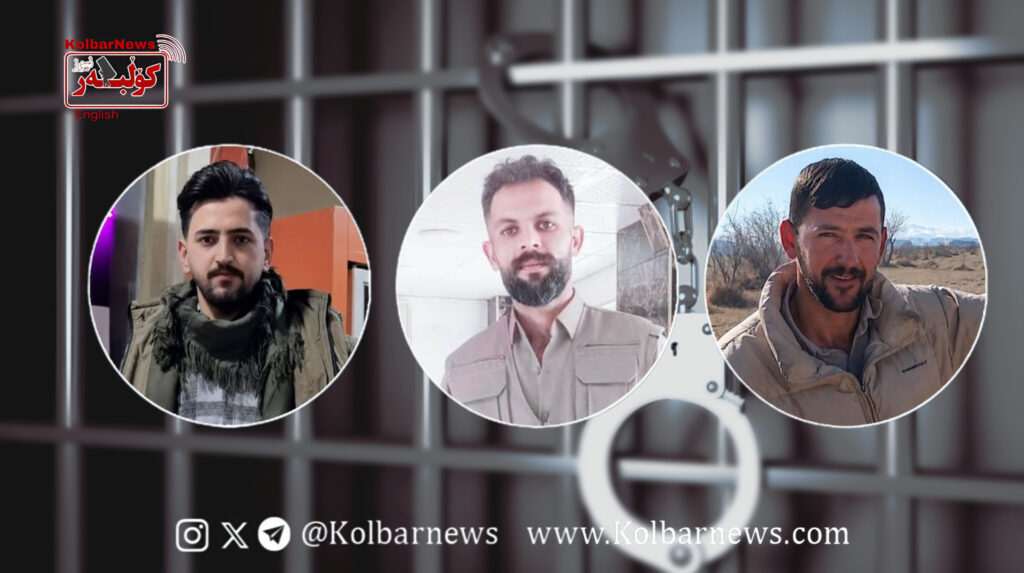

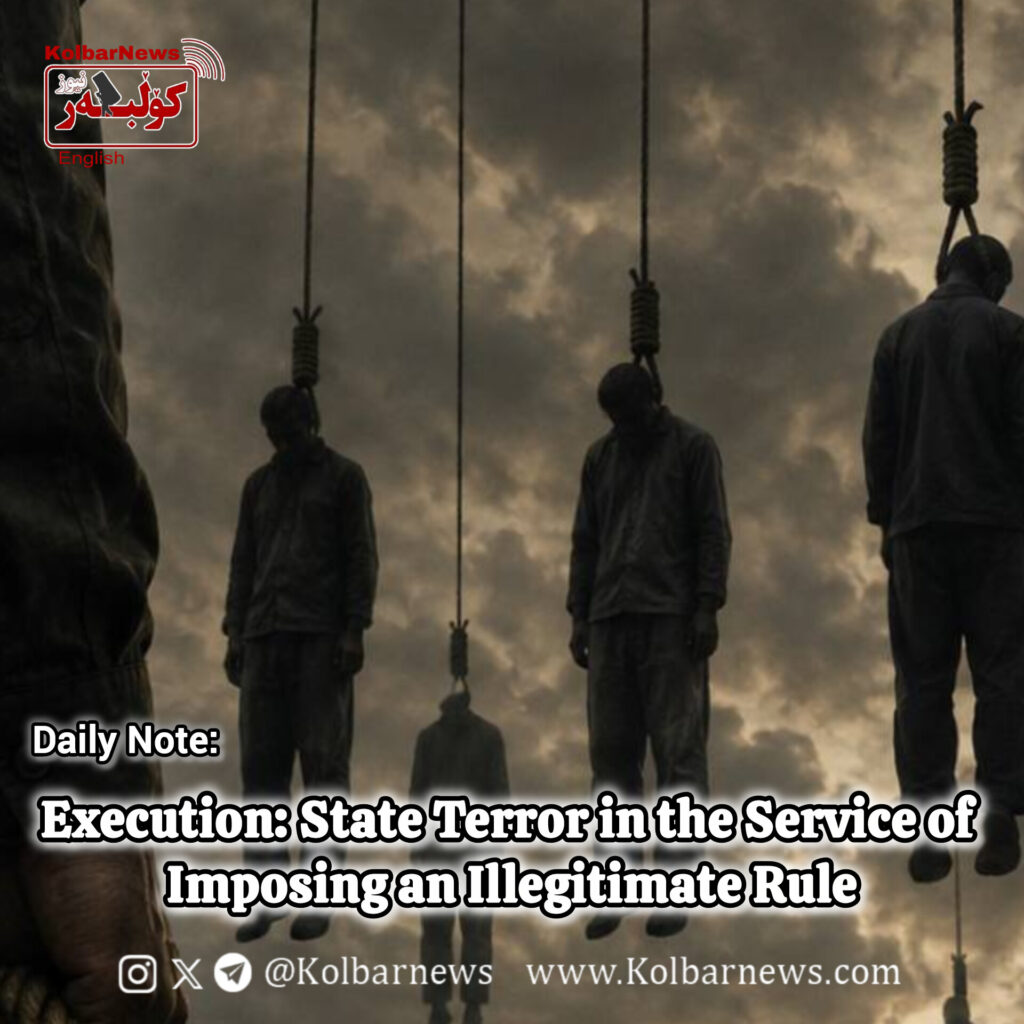
Execution, in any form and under any justification, is nothing more than organized and deliberate killing carried out by the state. When this punishment is placed in the hands of a government that possesses neither popular legitimacy nor respect for the most basic human rights, execution becomes an overt instrument of state terror; a tool for imposing silence upon society. The Islamic Republic of Iran is one of the clearest examples of such a situation, a government that throughout its existence has turned the gallows into one of the principal pillars of its political survival.
Since the ceasefire following the forty-day war, the Islamic Republic has executed at least one political prisoner every day. This trend is not accidental. Whenever political, social, or security crises intensify, the execution machine accelerates as well. A government confronted with widespread public dissatisfaction, a lack of social legitimacy, popular discontent, and multiple political and economic crises resorts to its simplest and most brutal instrument “the taking of human life” to demonstrate power.
Yet the execution of political prisoners is only one part of this policy of intimidation. Alongside the direct repression of political opponents, the Islamic Republic has also intensified the implementation of death sentences in cases classified as ordinary crimes. The aim of this dual policy is to normalize death, expand the atmosphere of fear, and desensitize society to state violence. When news of several executions is published every day, the government seeks to transform death into a routine aspect of daily life and into a repetitive occurrence that erodes public sensitivity.
According to the annual report of Iran Human Rights, at least 747 people were executed in Iran in 2025, the highest annual figure recorded since 2010.
The painful example of the execution of 28-year-old Asma Zarei a few days ago in Ardabil Central Prison illustrates the depth of this cruelty. She was pregnant at the time of her arrest, and her child was born within the prison walls. That child, now two years old, has been permanently deprived of a mother. The execution of a young woman is not merely the death of one individual; it is the condemnation of a child to life without a mother, a family to permanent mourning, and a society to bear a moral wound. In the women’s ward of Ardabil Prison alone, around 80 prisoners are held, and at least seven other women remain under death sentences; women who live every day and every night with the nightmare of hearing their names called for transfer to the gallows.
Iran recorded the highest number of executions of women in the world in 2025. During that year, at least 48 women were executed, representing a 55 percent increase compared to the previous year. This statistic reflects not only the intensity of repression but also the position of women within a system where misogyny, control over women’s bodies and lives, and the suppression of women’s voices are inseparable elements of its nature. Many women sentenced to death have themselves been victims of years of poverty, domestic violence, coercion, discrimination, and social abandonment. The very system that failed to protect them ultimately sends them to the gallows.
The Islamic Republic operates not only one of the most extensive but also one of the most brutal execution systems in the world. It remains among the few governments that continue to execute individuals who were under the legal age at the time of the alleged offense. It also carries out public executions, transforming the human body into a stage for displaying power; hanging people from cranes in streets and public squares so that death becomes a spectacle and fear is etched into the minds of citizens. Such scenes are public ceremonies of human degradation.
The government’s propaganda apparatus attempts to portray execution as a means of reducing crime, ensuring security, and delivering justice. Yet global experience and credible research have repeatedly demonstrated that the death penalty has no more effective deterrent effect than alternative punishments. No society has become safer by killing offenders. Social security emerges not from the gallows but from social justice, education, welfare, equality, psychological and social support, employment, poverty reduction, and a fair judicial system.
The reality is that people are not born murderers, offenders, or criminals. Many crimes emerge within conditions of structural poverty, unemployment, deprivation, addiction, violence, injustice, discrimination, and the collapse of social support systems. A government that reproduces poverty, hopelessness, and violence through its own economic and social policies, and then executes the victims of those very conditions in the name of justice, embodies the height of hypocrisy within an unjust order. It first abandons people to a cycle of deprivation and violence, then destroys them for the consequences of that same cycle.
In political cases, the issue is even more evident. The execution of political prisoners is an effort to eliminate opponents and spread fear throughout a protesting society. From its earliest years in power “from the mass executions following the fall of the Shah’s regime, through the 1980s, and up to the execution of protesters and political activists” the Islamic Republic has demonstrated that it refrains from no form of violence in eliminating opposition. Trials lasting only a few minutes, forced confessions, torture, denial of legal counsel, fabricated security cases, and death sentences are all familiar components of this machinery of repression.
Yet the more the government executes, the more it reveals its fear of society. Execution is not a sign of strength; it is a sign of a crisis of legitimacy. A government capable of ruling through the consent of the people does not need to erect gallows every day. The harsher the punishments become, the more they reveal the extent of the regime’s insecurity and inability to maintain its rule. During its 47 years in power, the Islamic Republic has failed to provide freedom, welfare, human security, or justice; now it seeks to compensate for its lack of legitimacy through fear.
Nevertheless, fear does not endure forever. Every execution leaves a family in mourning, but it also plants new anger within society. Every gallows may impose silence for a moment, but it becomes a lasting indictment in collective memory. History has shown that state violence may suppress movements, but it cannot destroy the desire for freedom and justice.
For this reason, the struggle against execution must be principled, universal, and without exception. Condemning political executions is necessary, but it is not sufficient. If we oppose only the execution of political opponents while accepting the execution of prisoners convicted of ordinary crimes, we have made the right to life conditional. The right to life is a universal right; it is neither a reward for political innocence nor a privilege that the state may revoke. Opposition to execution must include all human beings, regardless of the alleged crime, social status, beliefs, gender, nationality, or religion.
Today, the unconditional defense of abolition is an inseparable part of the struggle for a free, equal, and humane society. One cannot seek liberation from tyranny while remaining silent before the machinery of death. One cannot speak of human dignity while surrendering human life to the gallows. The struggle against execution is a struggle for the right to life, for human dignity, and for ending one of the most naked forms of state violence. It must become a broad social and political demand: no to execution, at any time, in any place, and against any human being.