
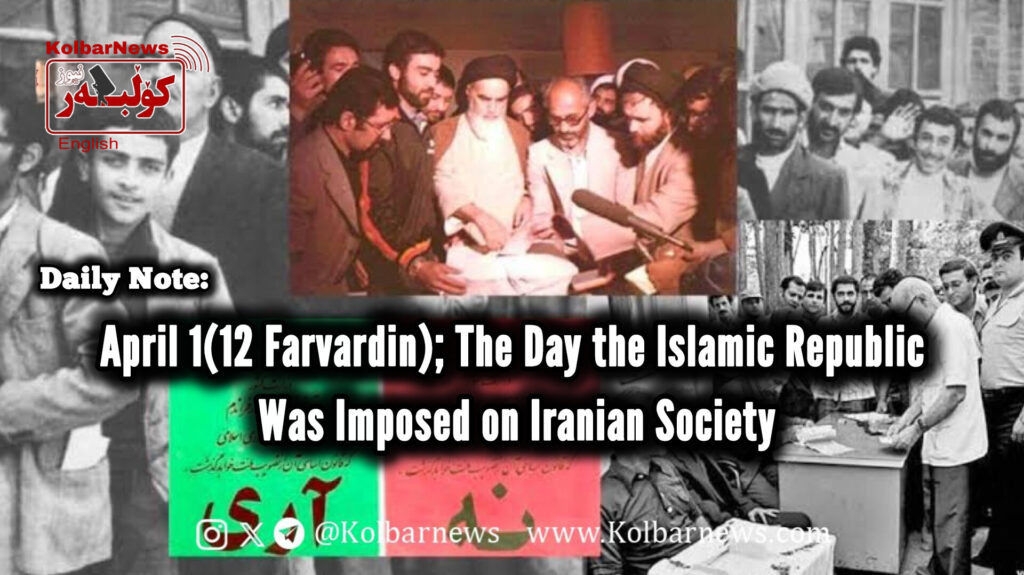
April 1, in the political and historical memory of Iranian society, symbolizes a decisive moment in the process of the appropriation of the 1979 revolution and the beginning of the formal establishment of a system built on political repression, ideological domination, institutionalized discrimination, and the systematic deprivation of individual and collective freedoms. On this day, what was presented to society as a “referendum” was nothing more than a political mechanism to legitimize a power that emerged from a popular revolution but, from its very first steps, moved in opposition to its fundamental demands.
After the collapse of the Pahlavi regime, Iran was in an exceptional situation. The masses, through widespread participation and heavy costs, had overthrown one of the region’s most significant dictatorships, and in the political horizon of society, demands for freedom, social justice, equality, and direct participation in determining their own fate held a decisive presence. However, at that moment, large sections of society had not yet fully understood the political and social nature of the forces that were rapidly seizing power. This gap in historical and political awareness allowed the clerical leadership, centered around Khomeini, to take the initiative and divert the revolution from its emancipatory content.
The April 1 referendum was carried out precisely in this context. From the outset, its design was deceptive, exclusionary, and devoid of any democratic standards. The central question was not based on a free choice between different forms of government but was framed as an imposed binary: “Islamic Republic, yes or no?” Within this framework, there was no opportunity to present alternative political options, nor was there equal space for public debate. More precisely, people were not faced with a real choice but with a form of political engineering aimed at the rapid transfer of power to a religious dictatorship.
The political function of this binary framing was clear. In an atmosphere where the majority of people had emerged with deep hatred toward the monarchy and the despotism of the Pahlavi regime, any “no” vote to the “Islamic Republic” was portrayed as support for the return of the previous order. Thus, millions who neither believed in a religious government nor supported the monarchy were placed in a political and moral dilemma. Under these conditions, many “yes” votes did not reflect a conscious choice in favor of the Islamic Republic but rather a rejection of the previous regime, the absence of real alternatives, the dominance of propaganda, and illusions about the nature of an Islamic government.
The urgency shown by Khomeini and his aligned forces in holding this referendum also stemmed from this reality. They clearly understood that the passage of time would allow more space for exposing the reactionary nature of the “Islamic Republic” project and would increase public awareness of the consequences of establishing a religious state. Therefore, the rapid organization of the referendum, before the formation of a free political environment, was part of a strategy to seize power and close off alternative paths for the revolution.
Nevertheless, even at that time, not all of society submitted to this spectacle. Conscious forces, communists, and the people of Kurdistan, who recognized the danger of establishing an anti-freedom religious order, boycotted the referendum and warned about its disastrous consequences. They correctly identified that clerical rule was not a continuation of the revolution but its political negation.
The claim of 98 percent participation and approval for the Islamic Republic, from the outset, was less a social reality and more a sign of the beginning of a pattern of fabrication, exaggeration, political engineering, and distortion of the public will. This figure was inconsistent even with observable geographic, political, and social realities. In Kurdistan, people widely boycotted the process, refusing to recognize the political legitimacy of the newly established system. In parts of Turkmen Sahra and some remote areas, either no ballot boxes were set up or real voting conditions did not exist. In many other regions, some citizens, despite political and psychological pressure, refused to participate or invalidated their ballots to express dissent. From this point on, the Islamic Republic consolidated one of its most enduring characteristics: replacing the real will of the people with manufactured statistics, electoral spectacles, and top-down reproduction of legitimacy.
Thus, April 1 marks the consolidation of the removal of the people from their decisive role in determining the fate of the revolution.
This date marks the official beginning of a system in which the repression of opposition, discrimination against women, suppression of oppressed nations, attacks on independent labor and popular organizations, and the consolidation of capitalist relations under the cover of religion became fundamental components of power.
Now, after decades of direct experience, it has become clear to broad sections of Iranian society that April 1 was not the day of establishing a “republic,” but the day a religious and class-based despotism was formalized. Today, women, workers, teachers, retirees, students, youth, the unemployed, oppressed nations, and all marginalized groups who have borne the weight of crisis, poverty, repression, and discrimination have, more than ever, confronted this political order. The nationwide uprisings of the past decade ‘from January 2018 and November 2019 to the revolutionary movement of “Woman, Life, Freedom” and the protests of last January’ clearly show that Iranian society is seeking a new horizon of freedom and liberation.
However, revisiting April 1 is not only about judging the past; it is also a political warning for today. The experience of the 1979 revolution showed that the overthrow of one despotism, if not accompanied by conscious organization, the independent presence of social forces, the formation of leadership structures from below, and the prevention of monopolization of power, can pave the way for a new form of domination. Therefore, the central lesson of April 1 is that no emancipatory transformation can succeed without collective awareness, sustainable organization, historical memory, and avoiding illusions about reactionary and opportunistic forces.
On such a day, it is fitting to honor the memory of all communists, revolutionary activists, and progressive, freedom-seeking women and men who stood against the establishment of the Islamic Republic and who lost their lives ‘whether on the battlefield, in prisons, or under torture’ in an effort to prevent the consolidation of this anti-human system.
Their memory remains part of the moral and political strength of today’s struggle.