

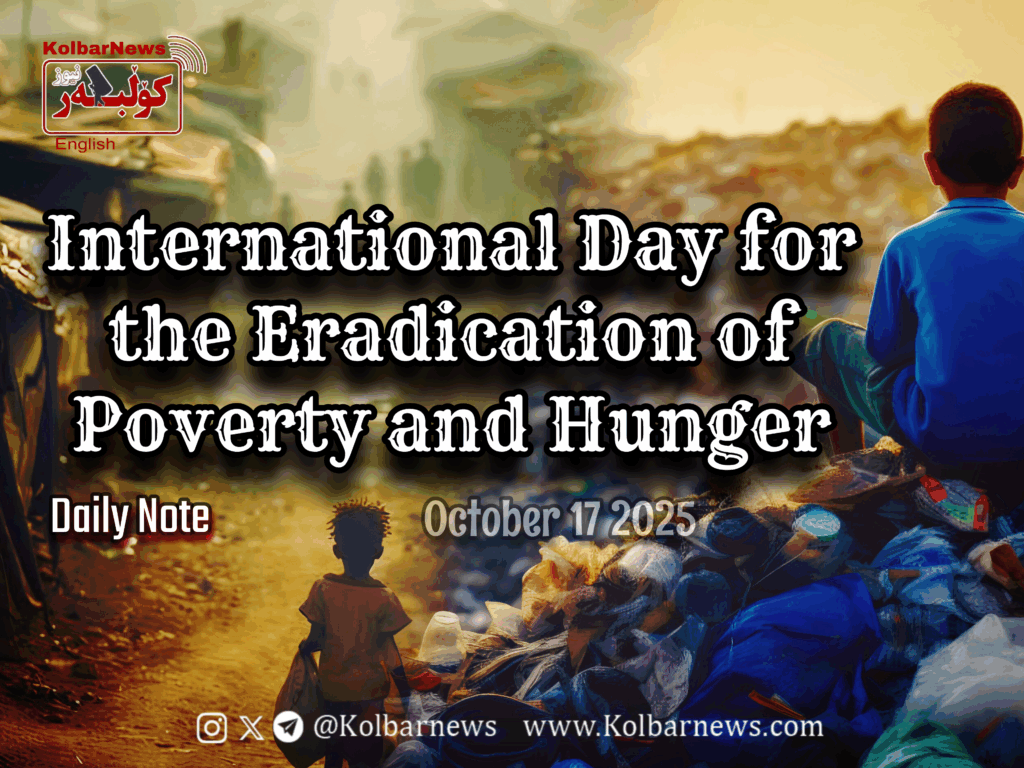
October 17th, has been designated as the International Day for the Eradication of Poverty. More than three decades have passed since the United Nations recognized this day in 1992, yet poverty still casts its shadow over the world as one of the greatest human catastrophes.
The history of observing this day goes back to 1987 and a gathering of about 100,000 people in the Trocadéro square in Paris, where the Universal Declaration of Human Rights had been signed in 1948. That assembly was held in memory of the victims of poverty, hunger, and violence, and laid the foundation for a global movement to fight poverty.
Global statistics paint a harrowing picture of world hunger: About 673 million people, equivalent to 8.2% of the world’s population, experienced hunger in 2024. Although this number shows a decline compared with 2022 and 2023, it remains higher than pre–COVID-19 pandemic levels. According to the World Food Programme, by November 2024 some 343 million people were facing acute hunger. The situation in some areas is so severe that famine has become a reality in Sudan, and famine is currently unfolding in Gaza.
Children are the hardest hit by the hunger crisis. More than 190 million children under five worldwide suffer from malnutrition, which has detrimental effects on their physical and mental development and threatens their futures.
According to available data, over 160 million children under five are stunted (shorter than their age due to inadequate nutrition). Half of these children live in Asia and one third live in Africa. Half of the annual six million child deaths are caused by malnutrition.
Hunger is driven primarily by three major factors: war, climate change, and intensified exploitation together with economic crisis. According to the United Nations Food and Agriculture Organization (FAO), global food production is sufficient to feed all 8.2 billion people on Earth, yet unequal distribution, wars, and economic crises leave millions hungry.
Global economic inequality has reached unimaginable levels. According to the NGO Oxfam, eight of the world’s richest individuals hold more wealth than half the planet’s population. The World Food Programme states that if just two cents a day of that wealth were allocated, it would be enough to provide a vitamin-fortified meal for students suffering from malnutrition. Rising food prices and income inequality have left 2.8 billion people unable to afford a healthy diet.
Iran, under the rule of the Islamic regime, today faces one of the worst poverty crises in its contemporary history. According to official statistics from the Statistical Center of Iran, over the past decade at least one third of the population’s purchasing power has been lost. The bitter reality is that more than 70% of the Iranian people now live below the poverty line, nearly 50% of whom are in absolute poverty.
Runaway inflation has pushed millions of Iranian families to the brink of collapse. The price of red meat has surpassed one million tomans per kilogram, dairy prices have risen by more than 80%, and bread has become about 95% more expensive.
Based on data from the UN Food and Agriculture Organization (FAO), 41% of Iranians suffer from moderate or severe food insecurity, and 36 million people do not have the financial means to afford a healthy diet. Protein consumption in low-income households has fallen to less than once per week.
Widespread poverty has severely affected not only livelihoods but also Iran’s social fabric. This situation has led to various social pathologies and harms such as prostitution, drug addiction, scavenging through garbage, sleeping rough in cardboard boxes, and an increase in child labor.
According to official statistics from the Ministry of Education, there are more than 3.2 million out-of-school children, while at least two million child laborers across the country are employed in dangerous conditions. The poverty and severe exploitation imposed on working and poor families keep their members under constant psychological pressure. They work from childhood through adulthood, yet they struggle to secure even a barely livable existence. Having leisure time has become impossible for them, and thinking about ways to change their fate faces enormous obstacles.
The reality is that capitalist solutions to end this vast human tragedy will do nothing but entrench the current situation. If there is to be an end to this condition, it will only be possible through the struggle to overthrow a system whose functioning produces poverty and hunger as one of its outcomes.
The struggle to overthrow the Islamic Republic is a struggle to lift seventy percent of the population out of poverty and unemployment, out of deprivation and destitution, out of unaffordable prices and dozens of other small and large social problems.