
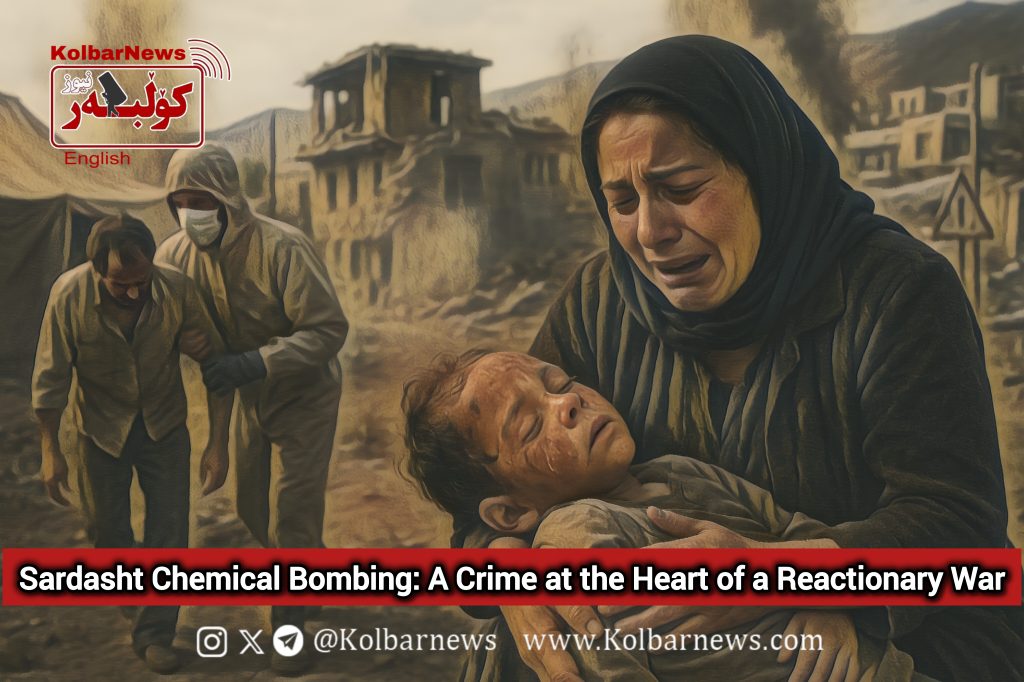
Today, Saturday June 28, 2025, marks the anniversary of the chemical bombing of the city of Sardasht. At 4:00 PM on June 28, 1987, in the midst of the devastating and reactionary Iran-Iraq war, warplanes of the fascist Ba’athist regime of Iraq committed a heinous act by dropping chemical bombs on four areas of Sardasht and its surroundings. The innocent and defenseless civilians who had no role in instigating or continuing that war became the victims of yet another human tragedy. This crime plunged the people of Kurdistan into mourning and wounded the hearts of all freedom-loving individuals.
In this historical atrocity, 130 people lost their lives and 8,000 others were horrifically injured or poisoned. The effects and consequences of this humanitarian disaster still linger, decades later, in the lives of the victims and their families. They continue to endure the excruciating pain and suffering, a burden that is also being passed on to future generations.
The chemical bombing of Sardasht marked a turning point in the Iran-Iraq war in terms of the use of weapons of mass destruction against civilians. Prior to this, the Ba’athist regime had used chemical weapons against Peshmerga forces and, in limited and experimental ways, on the battlefield. But using them against the civilian population of a city represented the peak of criminal escalation in that reactionary war. Since World War I, this was the first time such widespread use of chemical weapons against civilians by warring states had occurred.
Months after the Sardasht bombing, the Ba’ath regime carried out the Halabja massacre, in which nearly 5,000 people died and more than 7,000 were injured or poisoned. However, the imperialist states and those who had sold the chemicals and weapons to these war criminals consciously remained silent for their own political and economic interests, enabling the Ba’ath regime to repeat this atrocity on an even more horrifying scale in Halabja. Despite being signatories to the 1925 Protocol banning the production and use of chemical weapons, these states have had no qualms about producing and selling them during wartime.
In the 38 years since the chemical bombing of Sardasht, the Islamic Republic has done little beyond hypocritical victim-posturing and glorification of the eight-year war while absolving itself of crimes committed during that period. It has failed to provide care and treatment for thousands of chemical victims, particularly those from working-class and impoverished communities. This criminal regime, which had stationed military bases within cities such as Sardasht during the war, now cynically exploits this tragedy each year for state propaganda through staged commemorations while utterly neglecting the lives and fates of the surviving victims.
Although the perpetrators of this atrocity have been thrown into the dustbin of history, other criminals remain in power in Iran today. They are no less guilty than Saddam and his collaborators, continuing to commit crimes in cities like Sardasht, torturing and persecuting the children and relatives of those very bombing victims in prisons. They must be held accountable as partners in the war crimes of the Iran-Iraq war, and one day face justice for crimes against humanity.
The people of Kurdistan, and of the world, have etched the Sardasht chemical bombing in the historical record as a crime of Saddam and his accomplices. Yet they also remember the names of Khomeini, Khamenei, and all the other Islamic Republic officials who beat the drums of “war until victory,” sought to conquer Jerusalem via Karbala, and aimed to spread their reactionary regime throughout the region all as accomplices in these crimes.
Without a doubt, after the fall of this regime, one chapter of its voluminous criminal record will be dedicated to this mass killing and the suffering of thousands who were killed, wounded, or permanently disabled in the Sardasht chemical bombing. But the people will not be fooled by the crocodile tears shed today by the Islamic Republic’s leaders. They remember how Khomeini called the war a “divine blessing” and actively used it to consolidate his rule.
The Islamic Republic embraced the war to crush the Iranian revolution, to reclaim all the democratic gains won during that period, to carry out mass executions of communists and dissidents, and to quash every demand and aspiration that emerged from the 1979 revolution.
On this anniversary of the Sardasht chemical bombing, we once again express our deep abhorrence of that reactionary war and its perpetrators, and we honor the memory of the defenseless souls who perished in that horrific crime.