

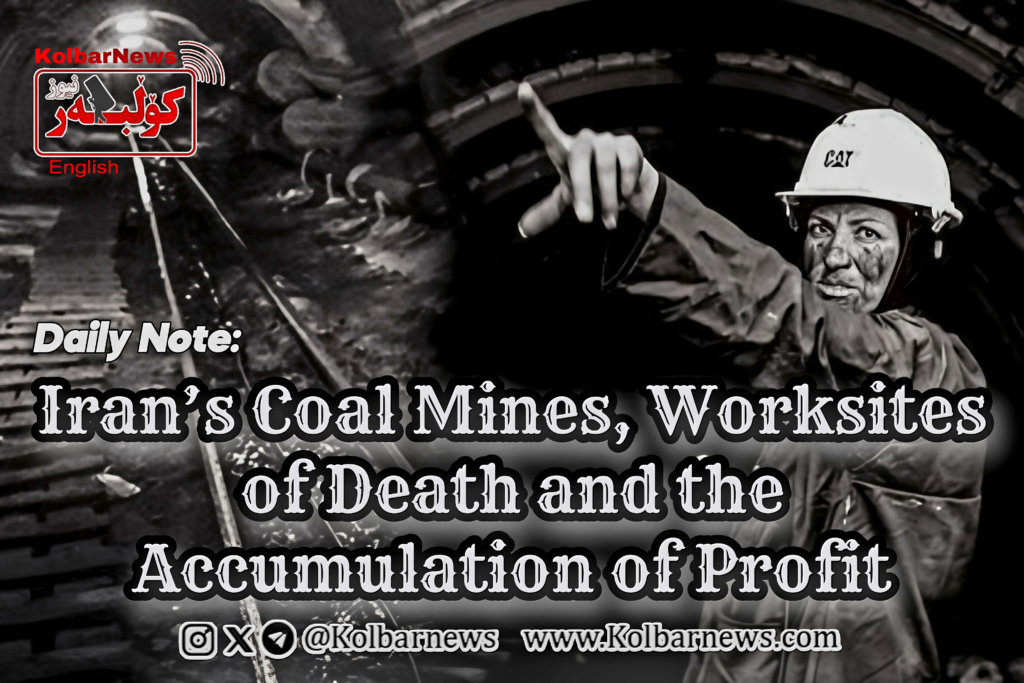
Iran is one of the most dangerous countries in the world for workers. According to the latest officially released statistics, 1,900 workers lost their lives last year alone due to work-related accidents, a figure that, even by the Islamic Republic’s distorted and censored statistical standards, lays bare the scale of the catastrophe. These figures present a clear picture of a reality in which workers’ lives hold no value in this system; what is sacred is profit and the accumulation of capital.
Among all sectors of labor, mines and above all coal mines have literally turned into killing fields for workers. Deep underground, far from the eyes of society, workers who earn monthly wages five times below the poverty line grapple with death every day; without any safety guarantees, under the domination of employers and a state that considers their lives a negligible cost for the continuation of exploitation.
Workplace accidents in Iran are not the result of random events; they are the outcome of a system that demands labor power be cheap, cheap to the point of death. A network of contractors, employers, and state institutions organizes production on the basis of low-cost contracts, minimal spending on safety, and maximum extraction and profit. The labor inspection system, instead of overseeing the enforcement of safety standards, has effectively become a tool for justifying employers and protecting capital. Within such a structure, the indifference of the government, the Ministry of Labor, supervisory bodies, and employers toward workers’ lives has become an ordinary, unwritten rule.
The list of deadly incidents in Iran’s coal mines in recent years alone speaks volumes about the depth of the disaster.
From the beginning of the current Iranian year (March 21) until about a month ago, five incidents occurred in coal mines in Damghan, Kerman, and Tabas, killing 11 workers; in all cases, the primary cause was cited as unsafe workplaces and the failure to observe safety standards.
May 2017: An explosion at the Zemestan-Yurt coal mine in Golestan Province buried and killed 42 workers.
September 6, 2020: The collapse of Tunnel No. 2 at the Hajdak coal mine (near Kerman) killed 4 workers.
May 2021: At the Eastern Alborz coal mine (Tarezeh, Dameghan), 2 workers died due to noncompliance with safety standards.
September 13, 2021: A collapse at the Hajdak coal mine in Kerman Province claimed the lives of 35 workers.
September 2023: An explosion at the Tarzeh mine resulted in the deaths of 6 more workers.
June 2, 2024: A collapse at the Abnil coal mine in the village of Bibi-Hayat (Kerman) killed 1 worker and injured 5 others.
June 16, 2024: The collapse of a sand and gravel mine in Shazand buried 4 workers under earth and rock; even now, the body of one of the victims remains trapped under the rubble.
These are only the incidents that have been officially recorded and covered by the media. In many small mines in remote areas, accidents are never recorded or remain confined to a few brief lines in local media.
The common thread in all these cases is that they were preventable provided safety standards were observed and genuine, independent oversight existed. The workers who die in these tunnels and are buried deep underground often work under temporary, blank-signed, or contract-based agreements; they earn less than $200 a month and are deprived of full insurance coverage, unemployment benefits, effective healthcare, and job security. In contrast, mine owners, contractors, and intermediary networks reap enormous profits based on this cheap and defenseless labor. The state and ruling authorities, through royalties, taxes, rents, and other privileges, are direct partners in this exploitation.
In such relations, a worker’s death is treated as part of the cost of production, a cost that can always be brushed aside with a few condolence messages or a token investigative committee. In this situation, only one factor can stop or at least slow, this cycle of crime; the class-based organization of workers themselves. Mine workers, like other segments of the working class, remain effectively defenseless against capital and the state if they stay fragmented and unorganized. Any individual protest is quickly suppressed, dismissed, or eliminated.
By contrast, where workers have managed to form even the most basic organizational nuclei, employers cannot as easily ignore safety principles, labor inspections cannot entirely conceal reports, accidents and violations of standards are publicized more quickly and widely, and the families of deceased workers are not left alone and isolated.
Under the current conditions in Iran, workers’ organization into their own independent class-based bodies councils, unions, safety committees, workers’ associations, and networks of solidarity is the only path capable of standing up to the criminal aggression of capitalists and the state.
The real response to this situation lies not in the crocodile tears of officials, nor in archived labor inspection reports, but in the organized power of the workers themselves and the linking of their struggles for workplace safety, fair wages, and a fundamental transformation of exploitative relations. Until that day comes, every mine collapse, every explosion, and every worker who dies under the rubble stands as an indictment of this system and all its defenders and accomplices.
