
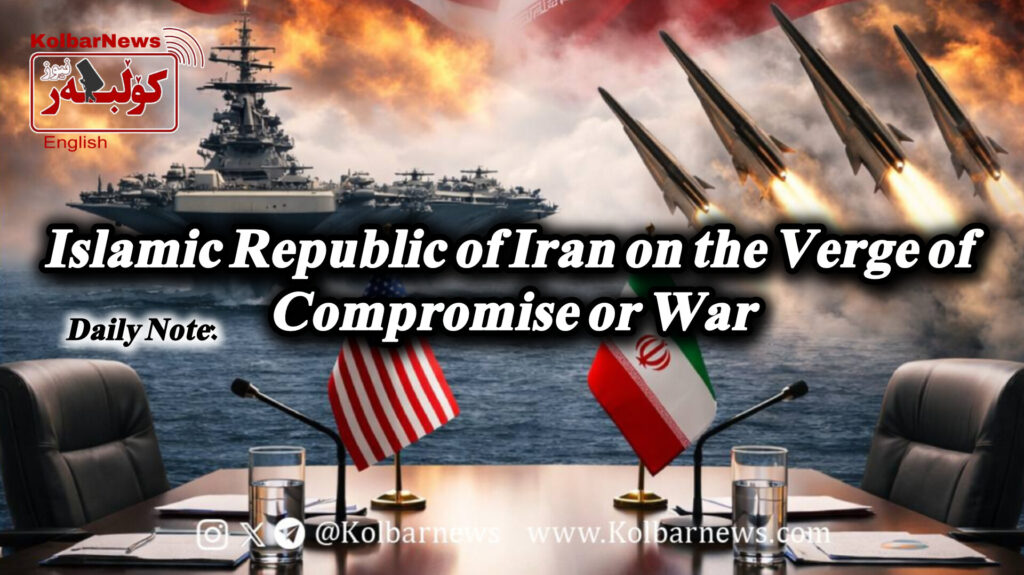
Today, Thursday, the third round of negotiations between Iran and the United States is being held in Geneva; negotiations that have once again brought the two sides face to face. But this time, the atmosphere is different. This round can be considered the most sensitive and perhaps decisive moment that diplomacy between the two countries has seen in recent years. Behind the negotiating tables in Geneva, the heavy shadow of war looms, and every word exchanged in those rooms appears to carry decisive weight.
What distinguishes these negotiations from previous rounds is the overt military atmosphere that has cast its shadow over the region. According to observers, the U.S. military deployment in the Middle East is nearly complete. Naval fleets, air forces, and logistical support have been positioned in locations that send their message without ambiguity. In such a context, today is not merely a diplomatic meeting; it appears to be the last open window for diplomacy. A narrow line remains between agreement and the beginning of a military conflict.
In his most recent annual speech to Congress, Trump delivered no explicit message to the public. He kept both options war and diplomacy open simultaneously an approach familiar to American policymakers, but one that creates fear and psychological pressure for those who would bear the consequences of war or agreement. As far as U.S. diplomacy is concerned, this deliberate ambiguity is itself a tool of pressure against the opposing side.
Amid all the questions raised these days, one fundamental question stands above the rest: why would the Islamic Republic enter a war it is already known to lose?
This question should not be taken lightly. Its answer lies in the survival logic of a political system that has, for decades, preserved its internal cohesion by defining an “external enemy.” From this perspective, war can serve as an illusion of salvation for the rulers of the Islamic Republic; a means of silencing internal dissent and creating a climate in which questions about domestic performance are replaced by concerns about security. But this illusion cannot withstand military and strategic realities.
On the other hand, there is also the possibility that the American side seeks a “limited war” one intended to extract diplomatic concessions through military pressure.
However, even if this calculation appears precise at the outset, it confronts a simple reality, deciding to start a war is far easier than deciding how to end it. “Limited wars” in modern history have repeatedly spiraled out of control. Another scenario also exists that the United States may launch heavy and widespread strikes from the outset, believing that a decisive first blow could weaken Iran’s capacity to respond and contain the consequences. Both scenarios whether limited war or large-scale attack would be disastrous for the present and future interests of the people of Iran.
Yet amid all these strategic calculations, the present condition of the Iranian people is often overlooked, people who are already burning in the fire of severe inflation and poverty. Iran’s economic situation has reached a point where the majority of society struggles to meet daily needs, and this situation continues to worsen. To this economic pain must be added a fresh wound: Iranian society is still in shock from the massacre of tens of thousands of people on January 8 and 9, 2026. This crime has pushed the relationship between the majority of the population and the government beyond the boundaries of hatred and alienation. On top of these heavy burdens now rests the added weight of uncertain anticipation of war, an anticipation whose end and consequences remain unclear. This combination has placed immense psychological pressure on a society that has endured successive crises for years.
A simple assessment shows that the Islamic Republic will emerge weaker in either possible path. If negotiations lead to an agreement, the regime will be forced to accept conditions it had resisted for months. In other words, it will retreat under U.S. pressure. As a result of such retreat, internal fractures within the ruling structure will surface, and a period of intensified possibly violent power struggles at the highest levels may follow. But that is not the whole story. If war occurs and military infrastructure is destroyed, what remains of Iran’s economic infrastructure will also face devastation that could take generations to rebuild. In both cases, the outcome will be a weakened regime. This weakening does not necessarily mean its immediate collapse, but it creates an opportunity that Iran’s civil society, social movements, and especially the labor movement must be prepared to use.
The opportunity for change will emerge from within this structural weakness once the current uncertainty is resolved.
If the worst happens and war becomes reality, one thing is already clear, the Islamic Republic has no plan for the safety of the people and will not have one. A regime that has, for decades, treated its population as instruments of ideological survival will abandon them in moments of real danger as well.
In such a moment, only one thing can serve as the people’s shield: human solidarity with one another.
This solidarity must take concrete forms sharing information for shelter, helping vulnerable neighbors, protecting women and children, and preserving local communication networks. In the midst of bombings and explosions, people must not abandon each other. More than that, war would be a test of what we are as a society. What we demonstrate in that test will become the foundation of the society that must be built in the aftermath of war and after this regime.
Today’s negotiations in Geneva are not merely a diplomatic meeting; they represent a point that could shape different possible paths in Iran’s history. Whatever path lies ahead, the people of Iran must place themselves at the center of this analysis. Warmongers on either side offer no meaningful promise for the people of this society. Moving beyond today’s harsh conditions toward a brighter future and building a society grounded in security, freedom, stability, and prosperity will only be possible through the efforts of the people themselves and their progressive forces.