

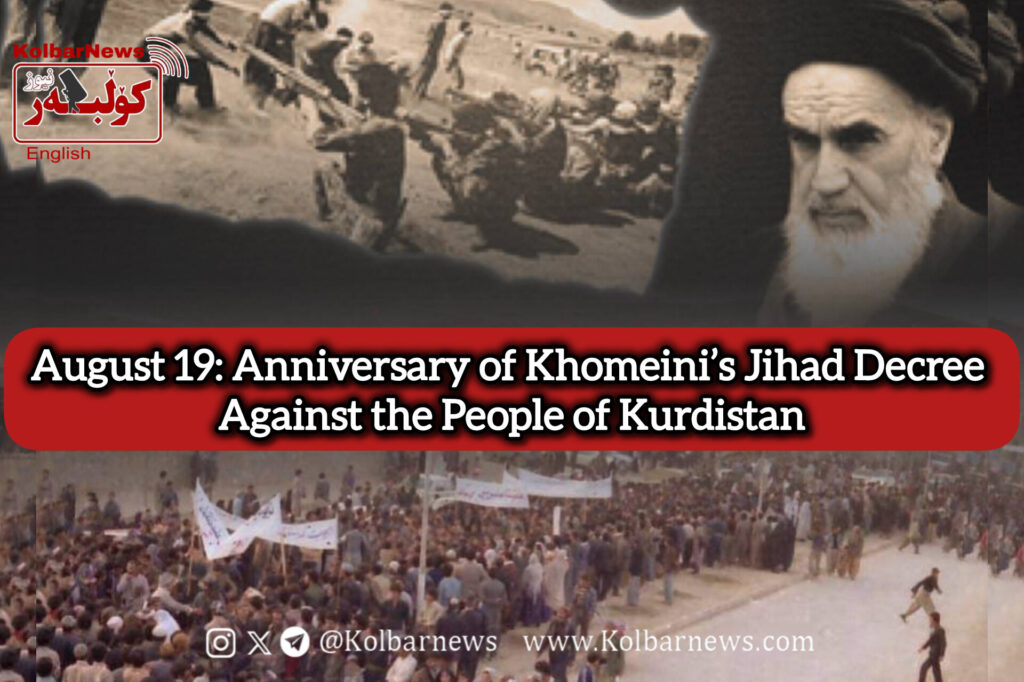
Today, Tuesday, August 19, marks the anniversary of Khomeini’s decree of jihad against the people of Kurdistan. Forty-six years ago, on this day, Khomeini ordered the Revolutionary Guards, the army, committees, and various armed groups under his command to march on Kurdistan from all directions and crush the popular revolutionary uprising of a people determined to defend their achievements.
However, the attack on Kurdistan on August 19, 1979, was not an isolated incident. In reality, it was part of the broader process of suppressing the Iranian Revolution. This policy began not on August 19, but immediately after the Islamic current came to power. In late March 1979, under the orders of commanders of military garrisons loyal to the new regime, the people of Mahabad and Sanandaj were fired upon: 20 were killed in Mahabad by direct gunfire, and nearly 200 lost their lives in Sanandaj due to shelling. At the same time, the newly established regime was able to win over parts of the local reactionary forces. They armed feudal lords and tribal leaders, organizing them into a reactionary body called the “Council of Kurdistan Tribes.” They also strengthened the Islamic current under Ahmad Moftizadeh’s leadership in Sanandaj.
On April 20, 1979, the regime instigated war between Turks and Kurds in Naqadeh, dispatching Revolutionary Guards under the reactionary cleric Mullah Hassani to massacre people and plunder property. On July 14, Revolutionary Guards opened fire on the people of Marivan, killing 24 and injuring 40. In Sanandaj too, several people were killed by gunfire from stationed Guards.
The response of Komala and the people of Kurdistan to these actions was decisive, revolutionary, and mass-based. The people of Kurdistan boycotted the April 1 referendum to establish the Islamic Republic. In the same period, they staged a month-long strike in Sanandaj to expel the Guards, organized the historic mass migration of Marivan’s residents for the same goal, and marched from Sanandaj and other Kurdish cities toward Marivan, among many other actions. Komala, foreseeing a wider offensive by the regime, sought to prepare the people of Kurdistan for a long-term and decisive resistance.
The Islamic current, which had functioned as a state within a state for centuries, entered this phase with abundant financial resources, a nationwide mosque network, clergy acting as an integrated apparatus, and centralized leadership. With the Shah’s fall, it seized all the institutions and levers of power, quickly rebuilding what had been broken by the revolution. Neither the pro-Western liberals of the National Front nor the left and communist forces, hampered by various factors, managed to consolidate their strength. Only in Kurdistan did events fail to proceed according to the Islamic regime’s plan, and Kurdistan followed a separate course.
Before the August 19 attack on Kurdistan, students were suppressed at universities, the Turkmen Sahra uprising was drowned in blood, protests in Khuzestan were strangled at birth, and workers in Bandar Anzali and Isfahan were gunned down. But the Islamic Republic needed more preparation for Kurdistan. Thus, compared to other regions, the assault on Kurdistan was delayed. When the attack of August 19, 1979, finally came, the regime felt it had the necessary power to suppress the achievements of the Kurdish people. Its forces launched the assault from two directions, Urmia and Kamyaran only to be met with fierce resistance by the Peshmerga. Though the regime used air power and artillery to occupy Kurdistan, Komala issued a statement titled “The Kurdish People on Trial,” calling for comprehensive resistance. The flames of struggle soon spread across Kurdistan. Within three months, widespread Peshmerga offensives and daily street protests shifted the balance of power in favor of the people, forcing the regime to retreat, accept a ceasefire, and come to the negotiating table.
The triumphant return of Peshmerga forces to the cities, the massive welcome they received, and the flourishing of political activity, councils, and grassroots institutions marked the failure of the regime’s August 19 offensive and ushered in a new phase of the Kurdish revolutionary movement. People, especially the youth, devised innovative ways of organizing society: securing neighborhoods with mass participation, distributing food and essential goods, reviving medical and health services, keeping schools and offices open, addressing people’s problems, and spreading revolutionary and humanistic ethics. During this period, the Kurdish People’s Delegation was formed, taking semi-frontline control of Kurdish affairs.
For less than six months, while the regime prepared another offensive, Komala worked despite internal obstacles to ready the public for the inevitable confrontation. The Islamic Republic evaded genuine negotiations, using deceptive maneuvers to buy time. When ready, it launched a new attack in April 1980, this time from the Kamyaran-Sanandaj axis. Yet the regime could not seize a single stronghold without meeting heroic resistance a resistance that lasted for years and bogged down the regime in Kurdistan. Though it eventually gained military superiority, it never succeeded in forcing the Kurdish people into submission.
In reality, while resistance against the Islamic Republic was widespread, the balance of internal forces for implementing Komala’s program of people’s self-rule in Kurdistan was not uniform everywhere. Despite time limits and regional differences, the Kurdish people, for the first time, experienced grassroots governance, council-based administration, unrestricted political freedoms, the dismantling of feudal military remnants, redistribution of land to those who worked it, women’s mass participation in social activities, and the seeds of progressive education. For the first time, they no longer saw themselves crushed under national oppression and discrimination. The resistance that followed was, in essence, a defense of these achievements.
The biggest shortcoming was the lack of experience and time to train capable cadres to administer Kurdish society. Having endured decades of monarchy’s oppression, emerging from a suffocating society, the people and their organizations needed time to overcome these gaps. But the threat of regime offensives and the militarization of Kurdistan made armed resistance the dominant form of struggle, leaving insufficient opportunity to deepen and expand those gains.
The most important lessons of this long and turbulent resistance, full of heroism, are these:
The most decisive experience is that there must be no delay in forming councils at workplaces and neighborhoods. With the first breeze of freedom and shift in balance of power, people must establish grassroots power. The neighborhood councils in Sanandaj (Bankeha) are a key example.
The first step must be forming councils in neighborhoods, workplaces, and villages. As the balance of power shifts further, councils should extend to cities. Step by step, regime retreats must be matched by filling the power vacuum from below.
Plans must be made in advance to meet urgent economic needs, counter economic misery, prevent national and religious divisions, and seriously and responsibly work to end national oppression.
A practical roadmap must reassure people that Kurdistan will not turn into a battlefield of armed groups. True radicalism lies here. Mere extremism, especially by non-working-class forces, cannot guide society through such trials.
All these lessons and experiences can be traced through the 47-year history of Komala and the society of Kurdistan.
