

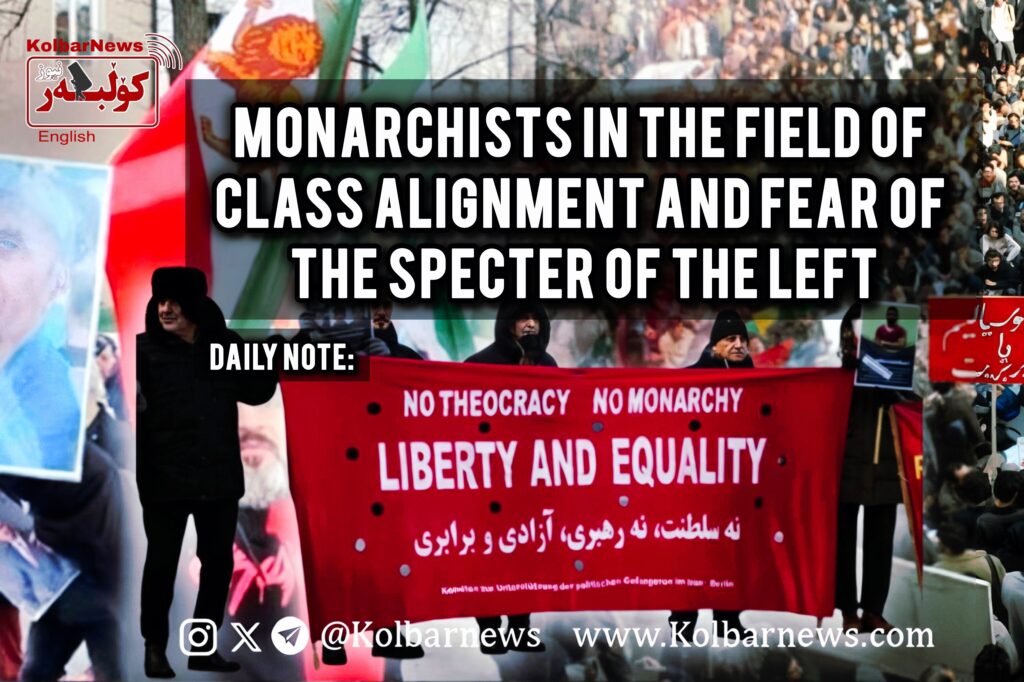
In recent weeks, monarchist forces have succeeded in organizing relatively large gatherings in cities such as Munich, Germany, Toronto, Canada, and several other centers. These events have attracted considerable attention in the current political climate surrounding Iran.
However, the mere ability to mobilize such gatherings is neither an unexpected phenomenon nor a sign of their political hegemony over Iran’s future. What we are witnessing is, above all, a reflection of the opening of the “question of political power” in Iran and the beginning of the formation of social and class alignments for the post–Islamic Republic future.
Iranian society has reached a point where the political, economic, and social crisis of the Islamic Republic has entered a qualitative phase. At such moments, social forces are no longer mere observers; they attempt to define their position within the future order. Whenever the question of political power becomes a real issue, class interests move from the level of the social unconscious to the level of conscious political choice.
For this reason, monarchist gatherings must be understood not merely as propaganda activities, but as signs of the beginning of competition among class forces over Iran’s future.
Iranian society, like any modern society, is not homogeneous. Industrial and agricultural workers, teachers, nurses, urban wage earners, the unemployed, the urban middle class, the commercial petty bourgeoisie, private capitalists, and at the top of the pyramid, the rentier bourgeoisie linked to the state, each have different visions for the future.
Over nearly five decades of rule, the Islamic Republic, through a combination of political repression, systematic discrimination, and the implementation of neoliberal economic policies, has deepened social divisions. Rent-based privatization, the destruction of job security, the collapse of public services, and the expansion of poverty have placed vast layers of society in a state of permanent protest.
This situation has brought together opposing forces against the Islamic Republic. From justice-seeking labor movements to bourgeois forces seeking integration into the global free-market order, various currents have aligned themselves.
In this context, monarchists represent a segment of the same class that seeks the transfer of political power without fundamental change in economic relations. Monarchist activity is the political expression of part of this class alignment; in other words, a section of Iran’s future bourgeoisie seeks to reconstruct capitalist order under a different form of political rule than the current one.
One of the most prominent features of recent monarchist gatherings abroad has been the widespread wave of anti-left slogans and behavior.
This phenomenon cannot be reduced merely to political culture or emotional reactions. What is visible in this behavior is a form of “political hysteria” with deeper roots. The Left in Iran today may lack a unified central organization or a powerful nationwide party, but it still exists as a political specter present in the field; a specter that raises dangerous questions for capitalist order. How should wealth be distributed? Who should hold economic power? What does social justice mean?
If monarchists truly believe that the Left is no longer an effective force in Iranian politics, then how can this level of propaganda and psychological mobilization against it be explained? Class enemies often recognize the potential power of their rival better than anyone else. Anti-left hysteria is, in fact, an indirect admission that the socialist program, strategy, and politics represented by the Left remain alive.
The language of the Left is still alive in society. Despite severe repression, historical defeats, and organizational fragmentation, this language has not been eliminated from Iranian society. Concepts such as social justice, equality, the right to work, free education and healthcare, opposition to unrestrained privatization, and critique of rentier capitalism continue to be present in social protests and among large segments of society. This presence does not necessarily mean actual organizational power, but it reflects discursive power. Even without classic party structures, the socialist current in its real content is capable of shaping the future political agenda.
Monarchists and other bourgeois projects fear precisely this capacity. Their fear of the possibility that social justice could become the central axis of Iranian politics is entirely understandable. Anti-left hysteria is not a reaction to the current strength of the Left, but rather a preemptive reaction to its potential capacity.
The reality is that monarchists offer no clear project to address widespread poverty and economic inequality. At best, their economic horizon consists of copying neoliberal prescriptions: entrusting everything to market logic, reducing social services and shrinking the state, and attracting capital at any cost.
But Iran’s crisis is not merely a crisis of the form of government; it is a crisis of the distribution of wealth and economic power. A society in which millions live below the poverty line will not achieve stability through changing political symbols without transforming economic structure and relations of production.
Monarchists already show weakness in the field of democracy, their tendency to eliminate rivals and attempt to homogenize the political field, and their hysterical opposition to the right of self-determination of the peoples living in Iran, indicate that their project cannot coexist with political plurality, consistent democracy, and the right of labor organization. Democracy cannot be demanded through slogans while being suffocated from the outset through threats and labeling.
The Left, a force without a center yet alive, is one of the defining features of Iranian society today. The social Left may appear fragmented from the outside, but it has a high capacity to reproduce discourse and shape social demands. The Left today can influence the future agenda even without capturing formal power; it is enough to keep fundamental questions alive: Who produces? Who decides? Who benefits?
The monarchists’ hysteria against the Left, on the one hand, is less a sign of their strength than a sign of fear of the return of these questions, and on the other hand, contrary to appearances, is not a sign of the Left’s weakness, rather, it shows that even in the absence of a unified organization, socialist ideals have not left the field. The specter that has been declared “dead” many times still moves within Iran’s political space, and it is precisely for this reason that its enemies are forced to constantly shout against it.
Recent monarchist mobilizations show that competition over Iran’s future has entered a serious stage. Bourgeois forces are organizing themselves to establish their hegemony in the event of political opening. But Iran’s future is not predetermined. In the face of a project that seeks political change without social change, the task of left and socialist forces is clear: organizational and discursive convergence, and transforming widespread social discontent into a program for freedom, economic equality, and real participation of the people in power. Otherwise, the danger is that the Islamic Republic may fall, but the relations that keep the worker exploited, voiceless, and without rights will remain.
