

Writer: Roman Miraki
Zagros fires
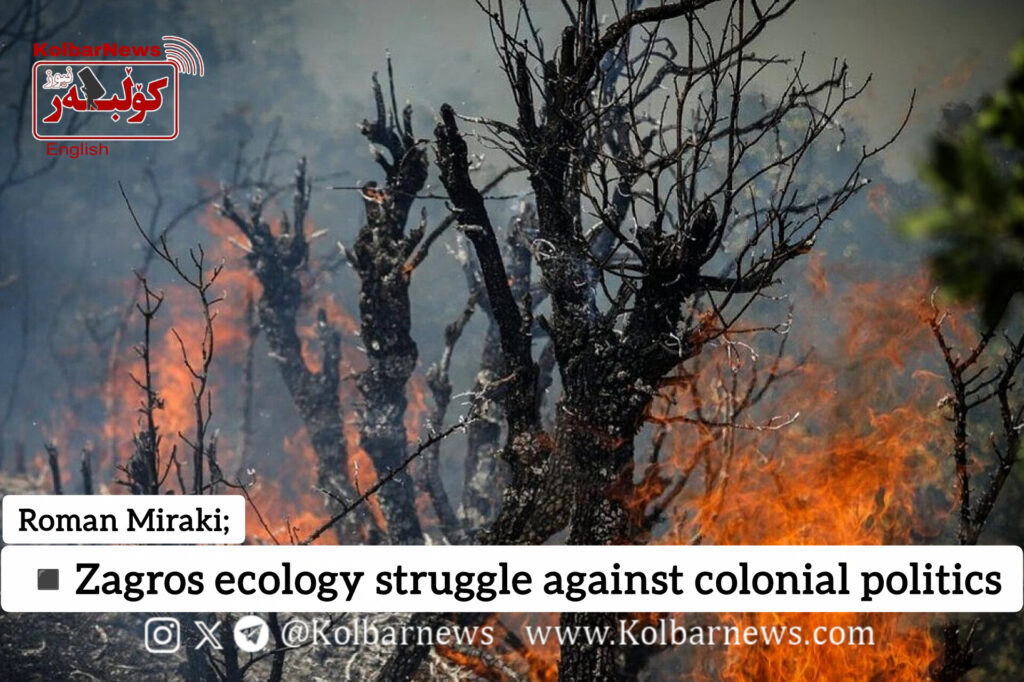
Zagros, as one of biological treasures of Iran and world, falls victim to widespread fires every year. These fires usually start in late spring and continue until early autumn. Unlike in past when natural factors were main cause of fires, today human factors play a key role in this disaster.
Conversion of forests to agricultural land, expansion of residential areas, and even deliberate actions under pretext of military manoeuvres are among most important reasons that have set Zagros mountains on fire. This crisis has become a serious threat to environment and culture of region, especially in Kurdistan, where forests are an integral part of people’s identity.
Since 2018, at least 12 environmental activists have died while trying to control fires in Kurdish cities in Iran, including Marivan, Paveh, Kamyaran, and Sanandaj. Considering geographical extent of Zagros Mountains, deaths of two environmentalists in Lorestan and two others in Halabja, Iraqi Kurdistan, can be added to this list. Most recent case was Rebin Gorani, an environmental activist from Marivan, who was injured while trying to control a forest fire in Hanjiran and died on 5 September 2025.
Environmental activists see Zagros fires not only as an environmental crisis, but also as part of a broader struggle to preserve their identity, culture, and land.
Every year, environmental activists face severe repression by security agencies, their legal meetings are attacked, their peaceful gatherings are attacked, environmental activists have been illegally arrested and faced prison sentences and imprisonment many times. For example, this year, when Ismail Karimi lost his life in a fire in Kamyaran and his funeral was held in his hometown, security forces attacked funeral and environmental activists who had participated from different cities were arrested, and their cases are still open. Or last year, they attacked legal and annual meeting of Chia Association and with extreme violence, detained more than 20 people, men and women for hours and they have not even returned their mobile phones.
Colonial politics
One of important reasons that has turned forest fires in Kurdistan into a more complex crisis than an environmental disaster is deliberate and planned role of Islamic Republic’s military and security forces in these destructions. Dense and lush forests of Kurdistan, which begin in Mokrian region of Piranshahr and extend to Ilam, have become a strategic target for destruction of military and security reasons.
Environmental movement in Kurdistan is not only a reaction to destruction of nature, but also a response to historical oppression of society during Pahlavi and Islamic Republic eras. Centre periphery policies have imposed poverty and unemployment on periphery, and power structure has concentrated development in centre and condemned peripheral regions like Kurdistan to underdevelopment. Natural resources of these regions are being plundered to feed industrial centre. Repression of 1980s and 1990s reshaped politics in Kurdistan, and environmental movement is part of this reconfiguration.
Zagros, with its dynamic ecosystem, has been a platform for formation of human civilizations and economic self sufficiency of Kurdistan; from food production in plains to fruits and nuts in forests. But in recent centuries, centre periphery model has plundered its resources to compensate for territorial mismanagement. This exploitation, without regard to renewability of resources, has linked environmental crises to deep social divisions and has turned environmental movements of Kurdistan into most advanced ecological movements in world.
Environmental activists in Kurdistan face severe challenges such as lack of equipment, lack of government support, and direct risks to life, often leading to tragic deaths.
In addition to activists, institutions in charge also face a lack of budget and manpower; there is only one ranger for every 10,000 hectares, which is one tenth of global standard. Fires are just one of crises; changing forest use, pests, livelihood dependence of more than a million people on Zagros Mountains, grazing of more than half of Iran’s livestock in this region, and mafia smuggling wood for charcoal and horticulture have accelerated decline of forests. Activists respond with their limited equipment, such as fire extinguishers. But they are caught in a vicious cycle of reaction over proper action that prevents pathology of crises.
