

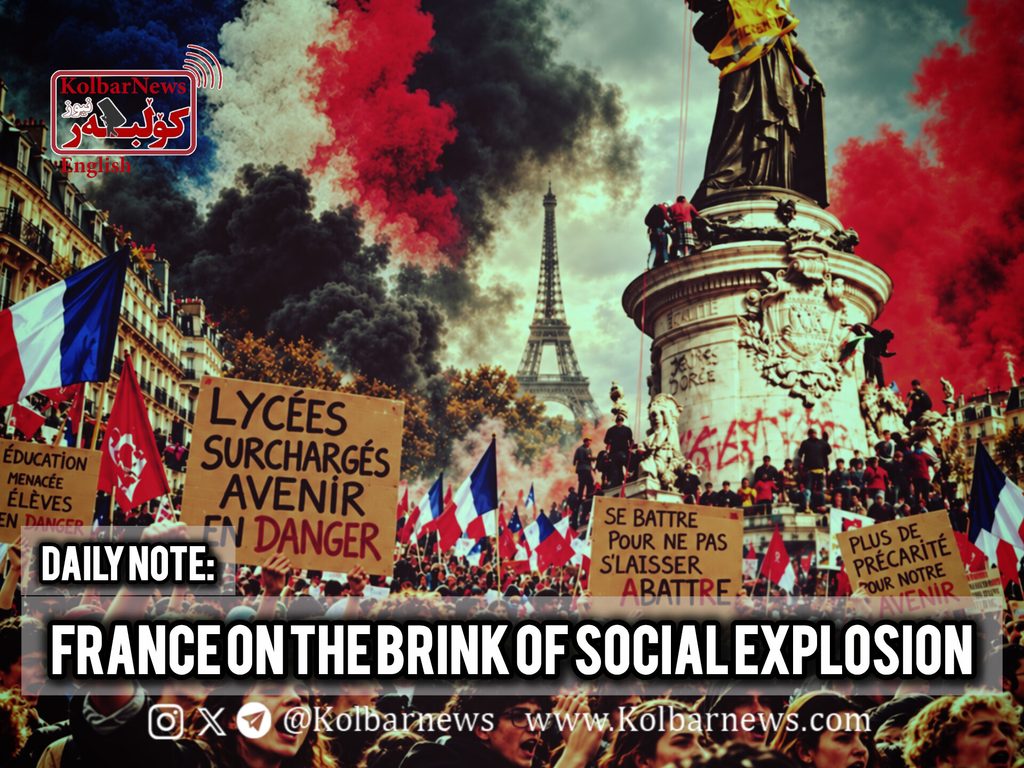
France has once again become the epicenter of a widespread social crisis. What began in mid-September 2026 with protests by students at a high school on the outskirts of Paris turned into a nationwide wave in less than a month bringing students, university students, teachers, energy-sector workers, firefighters, farmers, and veterans of the Yellow Vest movement into the streets together. On October 17, according to the Interior Ministry, 550,000 people marched across the country, while organizers put the figure at 800,000. The government’s response, however, was primarily a security crackdown. On that single day around 1,200 people were arrested, while more than 5,000 had already been arrested during the student protests.
These protests continue a cycle of struggles that began with the Yellow Vests in 2018 and continued through railway strikes, mass mobilizations against pension reforms, and the autumn 2025 strikes against austerity budgets. Yet a profound contradiction lies beneath this continuity. A society that has repeatedly mobilized millions of people has still failed to transform this social power into lasting political power. The roots of this inability must be sought in the collapse of political representation for the working class and the historic crisis of the French left.
Initially, students were protesting tangible problems. They complained about dilapidated school buildings, exhausting curricula, and teacher shortages. These demands emerged in the context of a budget that, according to trade unions, had eliminated thousands of education jobs. On October 6, around 450,000 people took to the streets, and teachers’ unions and energy-sector workers also joined the strikes.
At the same time, a call that had emerged on social media against rising fuel prices and the cost of living developed into a movement known as “October 17” forcing trade unions and political parties to adjust to it. This is the familiar pattern of the Yellow Vests: anger emerges outside traditional institutions, and rather than leading it, those institutions find themselves running to catch up.
In most European countries, the mobilizing capacity of trade unions has declined in recent decades, but France remains a striking exception. Even so, this social power has largely remained confined to resistance. Movements have sometimes forced the government into tactical retreats. Prime Minister Lecornu has once again promised that electricity prices will not rise during the winter.
But the balance of power has not changed in any lasting way. Most strikes in recent years have aimed to prevent the rollback of existing social gains rather than impose new demands. The labor movement is defending its remaining strongholds but still lacks the means to launch a political counteroffensive.
The government understands this well. It eases the pressure with minor concessions, seeks to wear down the movement until the holidays, and highlights isolated incidents of violence to distinguish the “legitimate protester” from the “rioter.” The prime minister’s description of the high school movement as “urban violence” shows how the authorities have turned a social issue into a security matter.
The most important feature of the current wave is the extensive participation of high school and university students. Rising living costs and the housing crisis have narrowed this generation’s prospects, education budgets have been cut, and the labor market awaiting them is increasingly dominated by temporary contracts and platform work. Today’s university students see themselves as part of the same class that will tomorrow face a future of precarious employment.
The connection between the youth movement and the labor movement is therefore no coincidence; it signals the emergence of a shared consciousness against the consequences of neoliberal capitalism.
Comparisons with May 1968 are tempting, but that generation mobilized largely around cultural ideals, whereas the current generation is rallying around food, housing, and employment prospects.
The emergence of student general assemblies that independently call demonstrations is a nascent form of self-organization that could take the movement beyond fragmented protest.
The French working class is present, but it has largely lost the political means to represent itself. For decades, the Communist Party and the CGT trade union confederation were the two main pillars of workers’ organization. Beyond economic demands, they also emphasized political culture and class identity. However, the Communist Party’s participation in Socialist governments “from Pierre Mauroy’s government in the 1980s to Lionel Jospin’s government, which carried out even more privatization than the right-wing governments that preceded it” eroded its credibility. When parties claiming to defend workers became partners in austerity and privatization, the historical trust of a large section of the working class collapsed. Trade unions have retained some of their influence, but they cannot fill this void on their own.
In this vacuum, the rise of the far right is no coincidence. Workers who feel politically unrepresented are often drawn to forces that claim to be fighting the “ruling elites.” In the deindustrialized regions of northern and eastern France, once part of the Communists’ “Red Belt,” the right-wing National Rally now has a strong base. Yet this movement has no significant presence in strikes or in workers’ and student assemblies. Its success is less the result of an ideological victory than of the failure of the French left.
The danger is that, six months before the 2027 presidential election, exhaustion with protests that produce no results could become electoral capital for these same forces.
Jean-Luc Mélenchon’s France Unbowed has sought to respond to this crisis. It has managed to bring together sections of young people, immigrants, and dissatisfied left-wing voters, becoming the most important force on the left of the opposition. The government even accused the party of instigating the high school movement, an allegation its leaders rejected. Rather than explaining the reality, this accusation reveals the authorities’ fear of the streets connecting with an organized political force.
The main limitation of the France Unbowed project, however, is that it continues to operate within the logic of electoral politics and has not placed the working class, as the central force of transformation, at the heart of its strategy. This revives an old debate within the European left: does social change emerge from the ballot box or from the independent organization of the working class in workplaces, neighborhoods, and universities? The French experience shows that these two cannot be separated. Without grassroots organization, every electoral victory remains fragile; without a political horizon, every street movement eventually becomes exhausted.
Social discontent is spreading, and firefighters have extended their strike until December. But the absence of a powerful political vehicle capable of turning this energy into a lasting project leaves the field open to the far right. If students and school pupils can transform their assemblies into a lasting network and link it with strike committees in workplaces, a way out of the cycle of protest and failure may emerge. Otherwise, France will once again experience the familiar pattern, with mass protests eventually returning to the same political dead end.
France’s main problem today is not the weakness of social struggle, but the absence of a force capable of connecting that struggle to a political horizon. In a country where workers and students still have the capacity to take to the streets, the question is no longer whether protests will occur. The central question is which force will be able to turn this protest into a political alternative for France’s future.
