

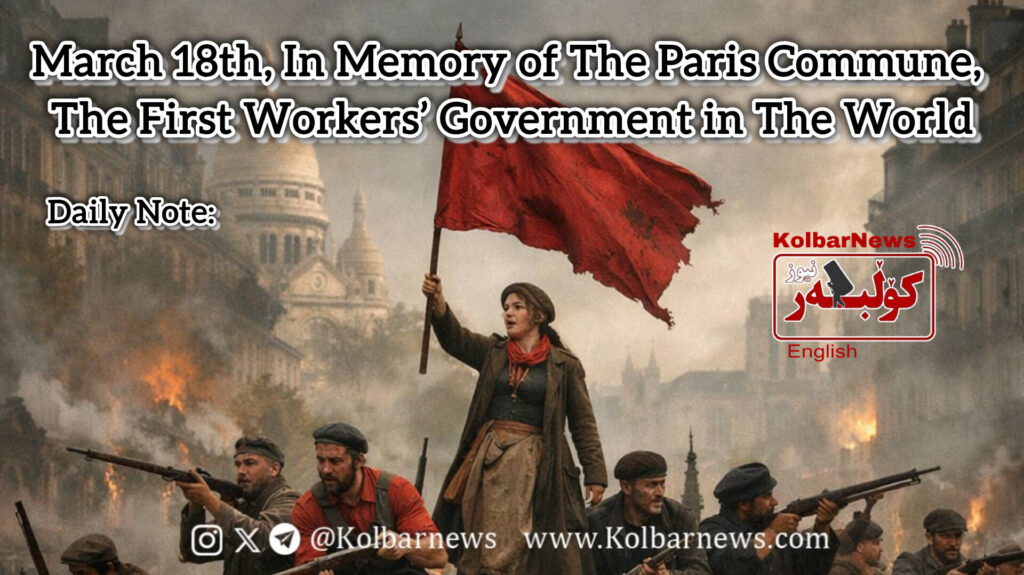
Today, March 18, marks the anniversary of one of the brightest events in the history of global freedom-seeking and labor struggles. On this day in 1871, the workers and armed people of Paris took power and established the first workers’ government in the world. The Commune was a great experience; a short but deeply meaningful one. An experience that still inspires workers, toilers, and freedom-seekers around the world.
The Paris Commune emerged on the basis of the political and military crisis in France. In 1870, Louis Bonaparte, Emperor of France, fueled chauvinist sentiments and, with the aim of expanding France’s influence in Europe, launched a war against the Prussian state. But this war ended in a humiliating defeat. The French army was defeated. Louis Bonaparte himself was captured by the Prussian army. The Prussian army advanced to the gates of Paris.
In such circumstances, the people of Paris took to the stage. On December 4 of that year, Parisians rose up. The remnants of the fleeing empire were swept away. The insurgent workers attacked the Bourbon Palace. They forced the legislative assembly to declare the dissolution of the empire and the formation of a republic.
Meanwhile, the people of Paris had armed themselves to defend the city. They organized the National Guard to resist the occupying Prussian army. The backbone of this force consisted of workers’ battalions. Socialists and revolutionaries also had significant influence among these workers. This point was very important, because in the midst of war and occupation, not only a new military force but also a new political force was taking shape.
At the same time, however, bourgeois forces quickly got to work. They formed a coalition and established the “Government of National Defense.” The new government, based in Bordeaux, feared the armed workers of Paris more than the Prussian army. Instead of focusing on the war against the occupiers, it prioritized disarming the workers. On the one hand, it negotiated with Prussia, and on the other, it planned to disarm the workers’ units in the National Guard. But the workers refused to disarm and rebelled against the bourgeois government.
Finally, on March 18, 1871, the puppet government could no longer withstand the people’s uprising. Its leaders fled Paris and settled in Versailles, a few kilometers from the capital. Thus, Paris fell into the hands of the armed workers. The Central Committee of the National Guard took power. Its first action was to form local councils and prepare for the election of a new government. After maintaining control over most areas of Paris and its suburbs, the committee handed power over to the elected representatives of the people. In this way, the Paris Commune was formed.
From the outset, the Paris Commune demonstrated a new form of government, one whose representatives were elected and could be recalled at any time by the people. The Commune Council had 83 members. It functioned as both legislative and executive authority. This was a clear sign of breaking with the old bourgeois state apparatus and an attempt to build a new form of political power.
The actions of the Commune were bold and historic. It abolished the standing army and entrusted military affairs to the armed people. This decision showed that the defense of society should be in the hands of the people themselves, not in the hands of an army separated from them. The Commune declared that land belongs to those who work it, the means of production belong to workers, and labor is a natural right of all human beings.
The Commune also attacked the class privileges of state officials. The high salaries of top officials were abolished. The highest salary could not exceed that of a skilled worker. Judges and high-ranking executive officials became elected and could be dismissed at any time by the people. These measures took politics out of the monopoly of the wealthy and professional power holders.
The Commune abolished the death penalty and publicly burned the guillotine. This was not just a legal decision, but a major human message. The Commune showed that a workers’ government sought to break with the machinery of terror and intimidation of the past.
In the field of education, major steps were also taken. Free education was established. Schools were freed from the control of the Church. Churches were dissolved and their property confiscated. All state aid to the Church was cut off. Religion was declared a private matter. The judiciary and education were separated from religion and from any belief related to individual conscience. This was one of the most progressive measures of the Commune.
The Commune also intervened in everyday life in favor of workers. Night work in bakeries was banned. The salaries of Commune officials were set at the level of workers’ wages. The police were transformed from an instrument of central power into an institution serving public welfare. Political functions of the police were abolished, and its officials were also subject to recall.
The Commune also declared freedom of speech, freedom of the press, freedom of assembly, and freedom of social and political organization. Factories and enterprises whose owners had fled Paris were handed over to workers’ associations. Employment agencies were abolished, and their functions were transferred to the municipalities of Paris’s 20 districts. All rents were forgiven for one year. The sale of pawned belongings in banks was prohibited. Even revolutionaries from other countries who had fought alongside Parisian workers took on responsibilities without discrimination. This showed the internationalist spirit of the Commune.
However, the Commune had powerful enemies. The Prussian state feared the spread of the message of freedom and equality to the territories under its control. Therefore, it allied with the defeated and fleeing bourgeois government of France. To suppress the Commune, it released 60,000 French prisoners of war and placed them at the disposal of the Versailles government. From early May, joint attacks by the Prussian army and the reconstituted army of the bourgeois government began toward Paris.
An unequal battle ensued. Workers and Communards fought to the death, but ultimately, after several days of bloody fighting, the Commune was defeated. About 17,000 workers were killed on the front lines, 30,000 were executed, and 70,000 were imprisoned or exiled. This horrific massacre was a clear example of the class hatred of the European bourgeoisie against a workers’ government. These crimes were carried out under the command of General MacMahon, who later became President of France.
The Paris Commune lasted only 72 days, but those 72 days left behind a world of experience and lessons. The Commune showed that workers can not only protest but also govern. It showed that a council-based form of power is a real possibility. It showed that the state can be organized not from the top down, but from below and through the direct will of the people.
The lesson of the Commune is also important for Iran today. Iran is caught in deep political, economic, and social crises. The Islamic Republic faces intertwined crises. The Iranian working class is exploited in the harshest ways and deprived of its most basic rights. Poverty, discrimination, unemployment, repression, and lack of rights have put the lives of millions under pressure. Even if the regime survives the current crises and war, it is clear that it cannot endure forever against the anger and resentment of the people.
In such conditions, the experience of the Commune offers a clear lesson: if a power vacuum emerges, it must not be filled by reactionary forces, the military, or top-down powers. This vacuum should be filled by councils elected by the people in neighborhoods, factories, workshops, universities, schools, cities, and villages. This is the new form of government that the Paris Commune first showed to the world. In Kurdistan as well, people have valuable experiences of managing affairs through grassroots institutions and social solidarity. These experiences can be decisive in a future revolutionary period that lies ahead.
March 18 is a reminder of a historical possibility: the possibility of people directly intervening in their own destiny, the possibility of organizing society on the basis of freedom, equality, and justice. The Commune was defeated, but it was not extinguished. It remained alive in the memory of the world’s working class and still says: the working people can rise, organize, and build a more humane world.