
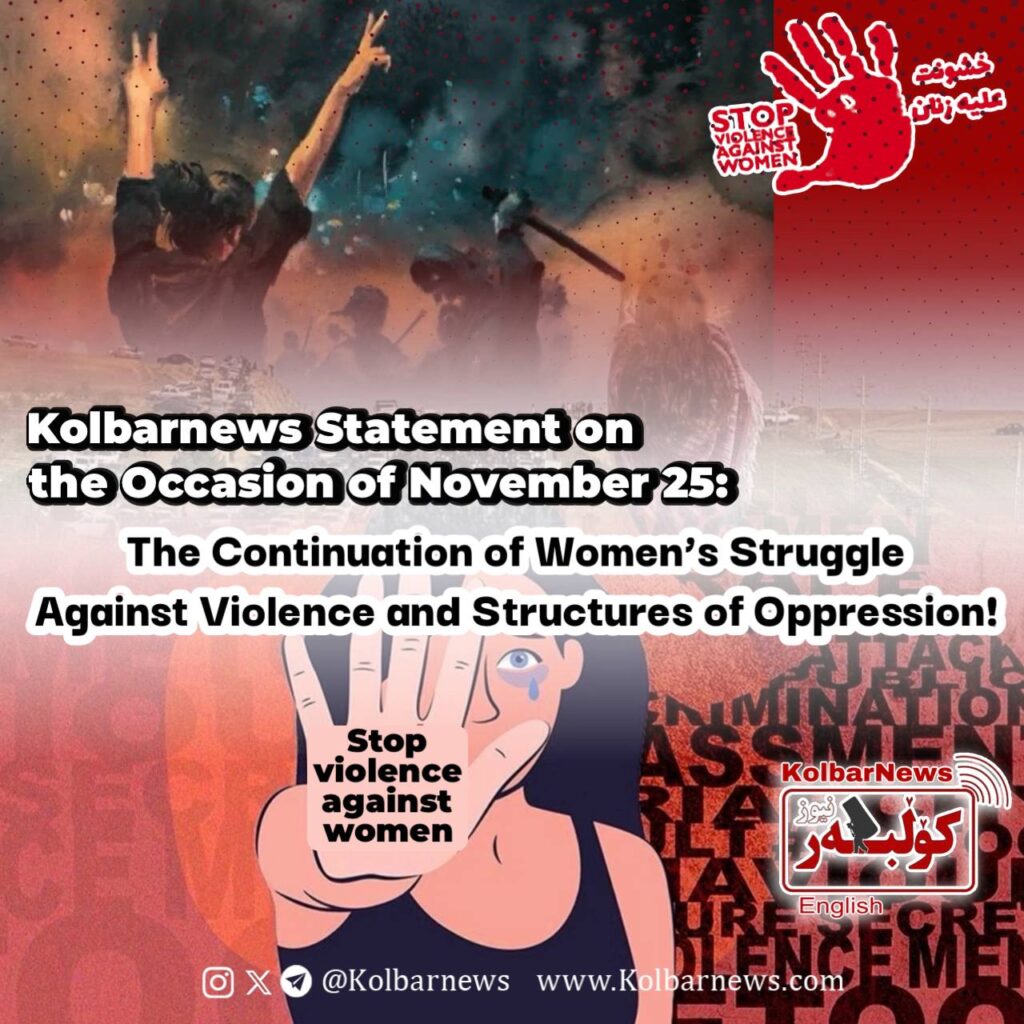
November 25, the International Day for the Elimination of Violence Against Women, reminds us of the truth that gender-based violence is not an individual incident or an accidental occurrence, but a deeply rooted structure within systems of power, domination, and inequality. In Iran and Kurdistan, under the shadow of the Islamic Republic, this violence is reproduced even more starkly through laws, religion, state policies, and the official discourse of the government. The intertwining of different forms of oppression also means that women’s experiences across these regions are not identical. In areas such as Kurdistan, violence is often multilayered and intensified: violence that begins with being a woman, and becomes entangled with national, class-based, and security-related oppression. Women at this intersection of oppressions face pressures that not only target their freedom and their bodies, but also restrict their identity, language, and their right to live as equals.
Violence against women in Iran, like in other parts of the world, is not merely the result of a few discriminatory laws or outdated traditions; rather, it is the logical outcome of a structure built upon patriarchal domination, the notion of ownership over women’s bodies, and political and economic control over the lower classes. Within this structure, gender-based violence serves as a tool to preserve the existing order—an order that reproduces capitalism, strengthens centralization, and reinforces male authority. The fusion of these mechanisms with the securitization of social life and a long history of political repression multiplies the pressure exerted on women.
The women who stood at the forefront of the revolutionary Jina uprising did not fight merely for the abolition of compulsory hijab or the right to choose their clothing; they rose up against an entire structure that legalizes, institutionalizes, and legitimizes violence. A structure that turns the female body into the main battleground of ideological conflict and, by institutionalizing various forms of violence from child marriage and forced marriage to economic mechanisms that trap women workers, women kolbars, and housewives in cycles of poverty and powerlessness, imposes its oppressive order on society. In Kurdistan, women have been especially recognized as leaders of this movement because they have lived through and resisted the compounded oppression of gender, class, and nationality for many years. Daily resistance, local organizing, participation in strikes and protests, and advancing a discourse of liberation have all shown that any struggle against violence will remain incomplete and ineffective without a radical perspective and a recognition of intersecting oppressions.
At the same time, decades of women’s struggle have shown that resistance does not go unanswered. Every small step taken in the streets, every voice raised against discrimination, every collective protest, and every daily act of defiance at home or in the workplace has cracked the patriarchal order. Deep cultural shifts, increased public awareness, the challenging of historical and religious taboos, and the emergence of a generation that rejects misogyny all signify that women’s resistance has not only been defensive, but transformative.
The revolutionary Jina uprising and the Women Life Freedom “Jin, Jiyan, Azadî” movement affirmed that women have succeeded in reshaping the dominant discourse and planting the vision of a new future in the collective imagination of society, a future that cannot be reversed.
On this day, once again we emphasize the struggle against violence toward women must move beyond symbolic gestures and transform into a radical, structural, and liberation-oriented struggle, a struggle that insists on de-objectifying women’s bodies, dismantling religious and patriarchal laws, and building an equal, free, and solidarity-based society. The global experience of women’s movements has shown that women are the driving force behind fundamental change, and that other radical movements must place women’s voices at the center of their struggle.
November 25 is not merely a date; it is a reminder of a collective commitment to building a world in which no form of violence is justified or tolerated. A future in which the liberation of women is the precondition for the liberation of all.