

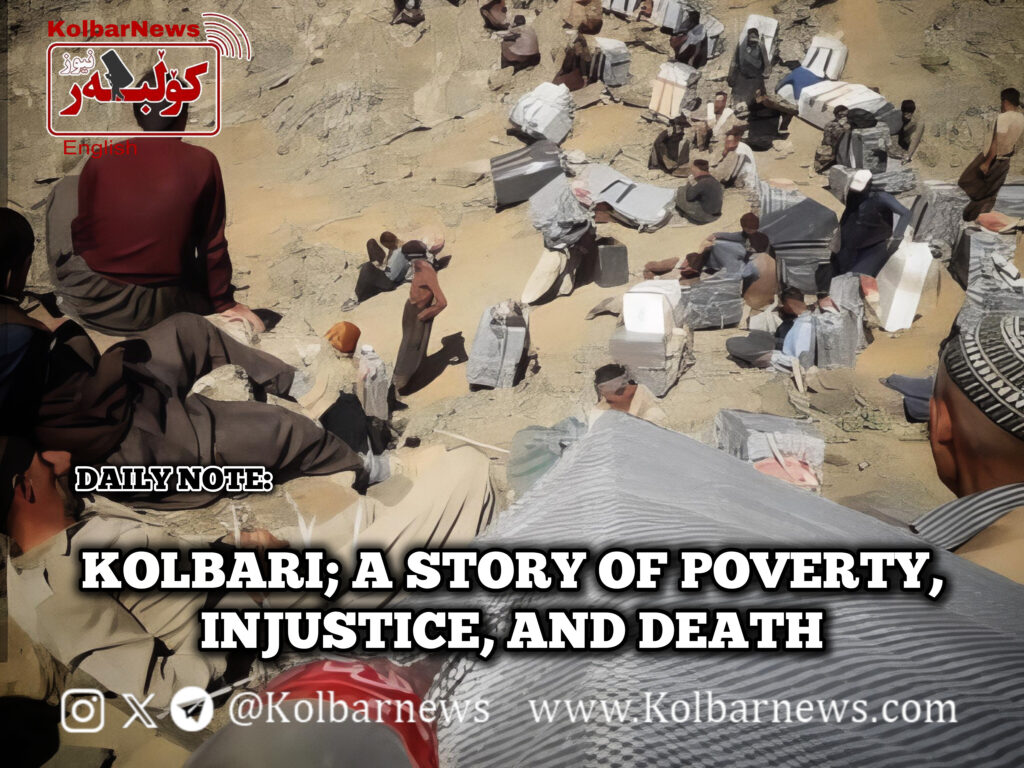
On the borders of Kurdistan, somewhere between rocky mountains and mine-laden paths, thousands of people race against death every day; not for profit, not for smuggling, not for wealth, but for the bread they must put on their children’s table. This work is called “Kolbari”; but in reality, it is forced labor on roads of death.
Reports by Kolbarnews show that attacks on the lives of Kolbars are not isolated incidents, but a systematic and recurring pattern. On August 6, 2026, Hassan Mostafazadeh, a 49-year-old kolbar and father of three, was brought down by direct fire from border regiment forces at the Henge-Jal border in Baneh. He was first taken to Baneh and then transferred to Tabriz due to the severity of his injuries. No one knows what condition he is currently in; we only know that the bullet that tore through his body did not kill poverty.
One day earlier, Goran Khedri was targeted by gunfire in the same area. Bakhtiar Amini lost his leg as a result of a landmine explosion. On July 23, Soheil Fardousi, an 18-year-old young man from the village of Dezavar, died instantly from a bullet that tore through his abdomen. On July 22, Rasoul Ghalandari, a 21-year-old kolbar from Qatur, was killed by subsequent shots fired by border forces after the initial shooting; without warning, without notice, without mercy.
These are only a few names; a few faces among hundreds. According to recorded statistics, in 2025, at least 57 kolbars were killed or injured on the borders of West Azerbaijan, Kurdistan, and Kermanshah. This figure, even if it represents only part of the reality, cries out the depth of the tragedy.
Kolbari is not a job; a job means security, insurance, a contract, a defined wage, and the possibility of returning home safely. Kolbari offers none of these.
A Kolbar is a person who carries heavy loads along mountainous, frozen, mine-laden routes filled with deadly ambushes. In return for a meager wage, all the risks fall on their shoulders. But for someone with no other source of income, this deadly work is the only way to survive. Poverty has crossed age boundaries: young teenagers, men over 60, female heads of households, educated young people who, after graduating from university, have been left in the ranks of the unemployed.
In border villages and cities, the absence of factories, investment, infrastructure, and a labor market has driven people toward work whose every journey can end in death, disability, or a life of permanent pain.
On the other side of these relations stand merchants and middlemen who take the main profits, without taking even a single step along the deadly routes of the Kolbars. Kolbars are wage laborers who receive a small share of the value of these transactions, while all the risks fall on them.
Nevertheless, officials of the Islamic Republic portray kolbars as “smugglers” to justify the shootings; a narrative that deliberately conceals the difference between Kolbari out of necessity and organized smuggling. Organized smuggling requires a network of power, capital, and official and unofficial institutions; something Kolbars neither possess nor play a decisive role in.
In various parts of Kurdistan, economic development policy has given way to securitization. Instead of factories, schools, hospitals, and infrastructure, people face checkpoints, restrictions on movement, and the danger of gunfire. The result of this policy is clear: expanding poverty, greater dependence on dangerous work, and an increasing number of kolbars.
Kolbari is the result of poverty, unemployment, and structural injustice. As long as poverty dominates people’s lives, banning Kolbari without creating an alternative will only increase the pressure. Ending this road of death requires a policy that places the lives and dignity of the workers of Kurdistan above profit, repression, and the securitization of the region. Kolbars are neither criminals nor security threats; they are the forgotten workers of a sick economy. And until their voices are heard, the borders of Kurdistan will remain roads of death.
