

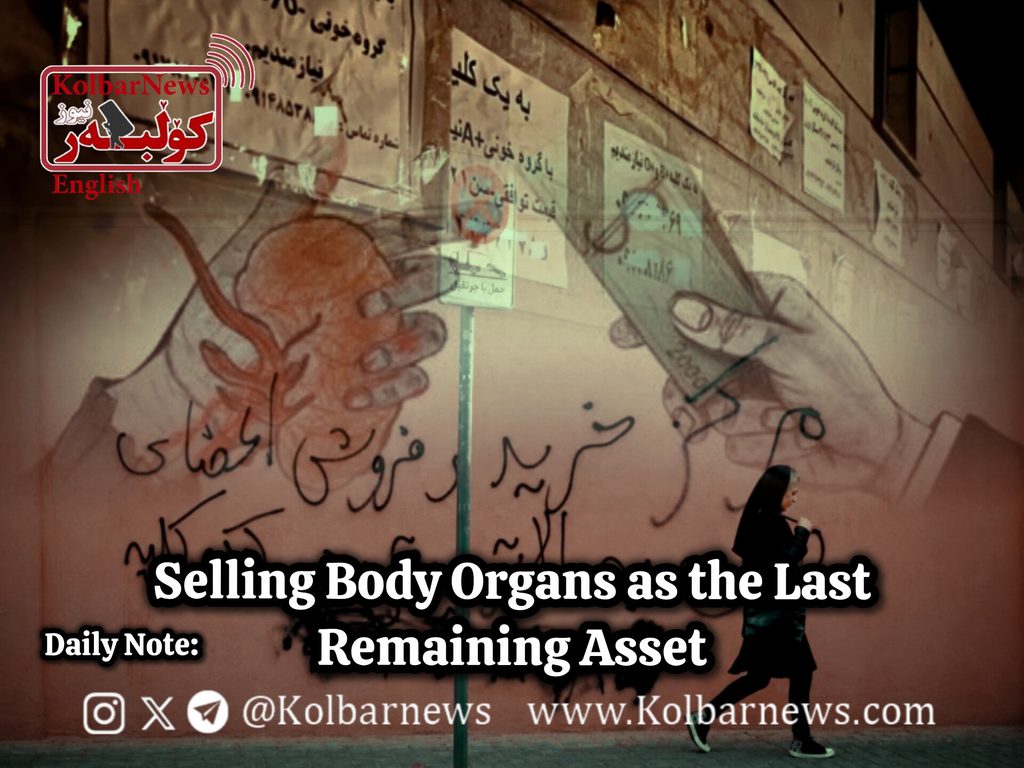
In a corner of central Tehran, there are walls that are no longer spaces for advertisements or public notices; they have become registers of a human catastrophe. Written on them are the phone numbers of people willing to sell their kidneys, parts of their livers, corneas, or bone marrow. These advertisements are not a medical phenomenon, but a clear indication of a class divide that continues to deepen.
The main question is not why an individual makes such a decision. The question is why the sellers almost always belong to the same class. None of these advertisements contain the names of capital owners, landowners, or people with inherited wealth. The seller is someone who owns nothing but their labor power and their body. When selling labor power is no longer enough to make ends meet, the body itself becomes the next thing to be sold.
Organ sellers are mostly wage earners, workers, small business owners, and people employed in the informal economy. These are the very people who keep the wheels of the economy turning through their daily labor, yet receive only a small share of its fruits. They have no savings, no property, and no support system to stand behind them in times of hardship.
The stories behind these phone numbers are much the same: rent and housing deposits that can no longer be paid, a cheque that has come due, debts piling up on top of one another, and medical expenses beyond a family’s means. The housing crisis lies at the center of many of these stories. For property owners, rising housing prices mean an increase in wealth; for tenants, the same rise means that a larger share of their wages is transferred into the pockets of others.
Therefore, selling an organ is not a way to improve one’s life. It is an emergency attempt to prevent a family from falling one step further down: from their home onto the streets, or from debt into prison.
In recent years, high inflation has rapidly driven up the cost of housing, food, healthcare, and transportation. Workers’ and wage earners’ incomes, however, have not kept pace with this growth. Inflation may appear to affect everyone equally, but in practice it functions as a mechanism for redistributing wealth from the bottom to the top. Those who own property, foreign currency, and physical assets benefit from it, while those who have nothing but wages paid in rials bear the cost.
Many people cannot achieve economic stability even with full-time employment and several jobs at once. The old promise that honest work would provide a dignified life has been broken for a large part of the working class.
When the market value of labor power falls below the cost of reproducing it, workers are forced to make up the shortfall elsewhere. First come loans and borrowing, then the sale of household belongings, and finally the sale of part of their own bodies. Organ selling is the final link in this chain, the point at which the market reaches the human body itself.
For workers and laborers, the body is their most important means of production. Drivers, construction workers, porters, and street vendors earn their income directly through their physical capacity. Capitalists own machinery, land, or money; workers have only their bodies.
Under normal circumstances, workers rent out their capacity to work by the hour, while their bodies remain their own. Selling an organ breaks this boundary. This time, it is not the body’s labor but the body itself that becomes a commodity. It is a form of commodification that penetrates all the way into flesh and bone.
The fact that sellers emphasize their physical health in these advertisements reveals this very market logic. Health, which until yesterday guaranteed their ability to continue working, has now become a product specification. And, as in any other market, the buyer usually comes from a wealthier class. Health, like many other resources, is transferred from the lower levels of society to the upper ones.
Selling an organ resolves today’s crisis by sacrificing the future. Workers sell part of their physical capital, the very capital on which their employment and income in the years ahead depend. A weakened body can endure less strenuous work and has less value in the labor market.
The money from selling an organ may cover a few months’ rent or a bounced cheque. But the root cause of the crisis “the fundamental gap between wages and the cost of living” remains untouched. A few months later, the person faces the same debts again, this time with a more vulnerable body.
This is the familiar cycle of the reproduction of poverty. The underprivileged sell their future assets today in order to survive, only to be poorer tomorrow than they are today. On the other side, the class that owns assets sees the same crisis as an opportunity for further accumulation.
Selling an organ is not an individual choice. This decision takes shape within an economic and institutional order whose support mechanisms have collapsed one after another. Effective unemployment insurance, affordable social housing, universal healthcare, and wages adjusted to inflation are all safeguards that should have stood in the way long before anyone reached such a point. When someone sells a kidney to pay the rent, it means that all these safeguards have failed.
The burden of this failure is not distributed equally among the classes. The upper classes are protected from the turbulence of inflation through their assets and connections; the middle classes are pushed downward; and workers and the poor ultimately turn to their last remaining asset: their bodies. This is inequality in its starkest form.
Every phone number written on those walls is evidence of the divide that has opened up between labor and life. The solution does not lie in lecturing sellers, but in restoring the value of labor: wages sufficient to cover the cost of living, the right to organize for collective bargaining, and a social protection system that treats housing and healthcare as rights rather than commodities. As long as a worker’s body is regarded as their last remaining asset, these walls will continue to fill up.